Downloaded from hlayiso.com
NATIONAL SENIOR CERTIFICATE EXAMINATION
NOVEMBER 2019
TOURISM
MARKING GUIDELINES
Time: 3 hours 200 marks
These marking guidelines are prepared for use by examiners and sub-examiners,
all of whom are required to attend a standardisation meeting to ensure that the
guidelines are consistently interpreted and applied in the marking of candidates'
scripts.
The IEB will not enter into any discussions or correspondence about any marking
guidelines. It is acknowledged that there may be different views about some
matters of emphasis or detail in the guidelines. It is also recognised that,
without the benefit of attendance at a standardisation meeting, there may be
different interpretations of the application of the marking guidelines.
IEB Copyright © 2019 PLEASE TURN OVER
Skip to contentMemorandum 
View all
Tourism Grade 12 IEB 2019 Memo
IEB Grade 12 Tourism memorandum from the 2019, 12 pages. Read online or get the free PDF download, question paper linked when available.
Publisher: IEB
Tourism · Grade 12 · 2019. Memorandum, 12 pages. Read online or download the PDF.
- Subject
- Tourism
- Grade
- Grade 12
- Document type
- Memorandum
- Year
- 2019
- Publisher
- IEB
- Curriculum
- IEB
- Pages
- 12
- File size
- 175.3 KB
Loading document…
Loading document…
1 of 12
Document textSearch extracted text and jump to a page.
Downloaded from hlayiso.com
NATIONAL SENIOR CERTIFICATE: TOURISM – MARKING GUIDELINES Page 2 of 12
QUESTION 1
1.1 Hospitality; accommodation sector. (Any 1 point)
1.2 Affordability; home environment; come and go as you please, unique
concept, original idea, accessibility to local knowledge and culture,
authenticity of the experience (not contrived). (Any 2)
1.3 People who want to experience first-hand the local way of living/culture,
budget travellers.
1.4 Any of the FOUR Ps of the marketing mix can be used, with valid points to
describe each heading. Choose from: product; price; place; people;
promotion; process; physical evidence.
Product: Airbnb – an online marketplace that gives people the opportunity
to let rooms, or their entire house to travellers.
Price: budget/middle class, lower income; varies according to location.
Place: worldwide
People: budget travellers, travellers who like to engage on a more personal
level with locals, off the beaten track. Also accept staff and owners of these
homes who host the tourists.
Promotion: online platforms such as social media, pop-ups.
Process: how is the service delivered: hands-on and personal interaction?
Facilities in the homes/rooms are usually made available to tourists; service
depends on particular owner.
Physical evidence: the homes/flats/rooms rented by the travellers.
(Packaging/programming and partnership are optional)
(One for the name, one for the description)
IEB Copyright © 2019 PLEASE TURN OVER
Downloaded from hlayiso.com
NATIONAL SENIOR CERTIFICATE: TOURISM – MARKING GUIDELINES Page 3 of 12
1.5 All four SWOT headings need to be addressed (strengths; weaknesses;
opportunities and threats) A mark awarded for maximum two correct points
per heading.
Strengths:
• Affordability – rates much lower than hotels and established
accommodation facilities.
• Accessibility
• Worldwide: wide choice of accommodation.
• Existing infrastructure means no minimal construction costs.
• User-friendly website helps tourists find their ideal place.
• Tourists can experience local culture and cuisine at grass-roots level.
(Any 2 valid points )
Weaknesses:
• Privacy issues may occur when staying in owners' homes.
• Hosts not trained in hospitality.
• Lack of facilities, parking and payment methods.
• Brand image can be damaged by behaviour of individual hosts.
• Brand expansion may violate tourism laws in some countries.
• Property development may violate residential building laws and the
privacy of neighbours in the area.
(Any 2 valid points)
Opportunities
• Airbnb can offer new services, opportunities for expansion and
diversification.
• Limitless opportunities for Airbnbs to open in rural areas, increasing the
availability of accommodation in areas not previously explored.
• Opportunities for contribution to social causes, corporate social
investment (CSI).
• Job creation, linkages created.
• Partnering with tourism companies can offer more complete packages
and enable businesses to expand.
• Host country's economy benefits from foreign exchange.
(Any 2 valid points)
Threats:
• Pricing structures are not regulated, and some hosts may exploit the
system by overcharging for services.
• The market can quickly become saturated as opportunists jump at the
opportunity to make extra money.
• Increasing costs of service industries may decrease the profitability of
Airbnb.
• Competitors who offer a similar type of service may enter the industry
and pose a threat to the business of Airbnb.
(Any 2 valid points)
[<https://www.freeswotanalysis.com/online-marketplace/774-swot-analysis-of-airbnb.html>]
IEB Copyright © 2019 PLEASE TURN OVER
Downloaded from hlayiso.com
NATIONAL SENIOR CERTIFICATE: TOURISM – MARKING GUIDELINES Page 4 of 12
QUESTION 2
2.1 Excellent online marketing; positive experience of visitors; affordability;
located worldwide; universal accessibility; customer feedback is available
online; tourists can utilise facilities for free; various rental options (can rent
an entire house or just a room); competitive player in the global market;
evidence of a growing market/demand. (Any 4)
2.2 Negatives:
Increased crime and drug use in local community; pollution; overuse of
resources such as water and electricity; temporary and poorly paid
employment; increase in demand for goods and services that might be a
problem if these cannot be met; cultural dilution and misunderstandings
may occur; infrastructure damage; increased carbon footprint; increased
prices affect locals, overcrowding, traffic congestion, inflated property prices
(or rates and taxes) may lead to locals not being able to afford to live in the
area. (Any 3)
Positives:
Employment opportunities; entrepreneurial opportunities; investment
opportunities; exposure to future travel opportunities/marketing
opportunities; increase in demand for goods and services, multiplier effect,
contribution to GDP, increased foreign income can be spent on
infrastructure development and conservation efforts; pride in the community
increases; improved standards of living for locals. (Any 3)
2.3 People/social: considering the positive and negative effects of tourism on
local communities, culture and heritage. Corporate social investment (CSI)
in tourism, such as financial or non-financial support given by tourism
companies to health/sport/education/youth projects.
Environment/planet: good environmental practices, such as resource
management (energy and water), waste management (reduce, re-use,
recycle), litter control, pollution control, environmentally friendly building,
promotion of indigenous flora and control of alien invasive plants in grounds
and gardens.
Economy/profit: the role of business. The responsible attitude of a tourism
business towards the people and environment it affects. Ways to practise it:
ownership, employment, procurement of local goods and services, etc.
IEB Copyright © 2019 PLEASE TURN OVER
Downloaded from hlayiso.com
NATIONAL SENIOR CERTIFICATE: TOURISM – MARKING GUIDELINES Page 5 of 12
2.4 Community/people/social; buying locally produced foods and artefacts;
respecting local traditions and beliefs; learning a few greetings in the local
language; asking permission before taking photos; not giving in to beggars
as this promotes begging, supporting local guides as this creates jobs.
Environment/planet: recycling of plastic/bottles; supporting sustainable and
responsible tourism organisations; volunteering; using local transport or
walking; not buying endangered animal or plant products, thereby reducing
the demand for them; not damaging local attractions by breaking pieces off
or littering; minimising waste by not using plastic bags or carrying your own
reusable water bottles; flying economy class makes more efficient use of
the space inside an airplane; buying offsets; (e.g. a Green Seat) as that
money can go a long way to funding projects around the world that aim to
reduce environmental impact; declining daily laundry services to reduce
water use; showering once a day instead of bathing; using reef-safe
sunscreen.
Economic/profit: Supporting local businesses creates linkages and a
multiplier effect, not haggling with locals for reduced prices, respecting local
traditions. Using less water and electricity also has economic benefits. (One
mark each for 6 correct points)
2.5 Fair share of the profit generated, fair working conditions, democracy (the
right and opportunity to participate in decision making), respect (for human
rights, culture and environment), reliability of service delivered (excellent
quality and safety guaranteed), transparency (accountability to ownership
and access to info), sustainability (use of resources), not using child labour.
(One mark each for any 3 correct points)
2.6 Sporting events/national conferences/hosted events.
2.7 Airbnbs provide extra accommodation close to big events and makes it
possible for more people to attend these events. This brings vast amounts
of money into the country where a big event is hosted and this filters
through to local communities. Airbnb encourages cultural exchange and
understanding between different cultures. The sharing of homes results in
the more efficient use of resources and because of the proximity to the
venues, travel distances are reduced and this benefits the environment.
(Any 3 correct points)
IEB Copyright © 2019 PLEASE TURN OVER
Downloaded from hlayiso.com
NATIONAL SENIOR CERTIFICATE: TOURISM – MARKING GUIDELINES Page 6 of 12
QUESTION 3
3.1 • electronic fund transfers (EFT) – online, quick, no cash is needed, can
keep track of payments, safe
• telegraphic transfers (SWIFT) – personal
• bank drafts – safe
• internet payments – online, quick, no cash needed, can keep track of
payments, safe
• foreign bank notes (cash) – neither electricity nor internet needed,
developing countries' preferred method of payment – locals prefer cash.
• credit cards (Visa, MasterCard, American Express, Diners Club) –
online, quick and no cash needed, can keep track of payments, safe
• traveller's cheques – can be claimed from insurance if stolen
• preloaded foreign currency debit cards such as Cash Passport
Card/Travel Wallet/Internal Travel Card – online, quick and no cash
needed, can keep track of payments, safe
3.2 Gross domestic product – measure of a country's total economic activity.
(Represents the monetary value of all goods and services produced by a
country over a specific time/financial year).
3.3 If the rand is weak compared to another country's currency, it is cheaper for
people from that country to travel to SA and they are more likely to stay
here for longer and to spend more money while in the country.
If the rand is strong compared to another country's currency, it is more
expensive for people from that country to travel to SA and they are less
likely to travel to SA. If they do travel to SA, they are likely to stay for a
shorter period of time and spend less money while they are here.
3.4 More international tourists bring money into the country that wasn't here
before and this benefits our economy. With local tourists, the same amount
of money circulates in our economy; there is no nett inflow of money into
our country.
3.5 International tourists bring money into the country that wasn't here before
and this benefits our economy. With local tourists, the same amount of
money circulates in our economy; there is no nett inflow of money into our
country. (Any 2 good points)
IEB Copyright © 2019 PLEASE TURN OVER
Downloaded from hlayiso.com
NATIONAL SENIOR CERTIFICATE: TOURISM – MARKING GUIDELINES Page 7 of 12
3.6 3.6.1 England's. Every pound sterling will cost you ZAR17,751. This
makes it very expensive for SA citizens to travel to England.
3.6.2 Japan's. Every yen will cost you ZAR0,121. South Africans will get
many more yen for their rands.
3.6.3 ZAR = 10 000
AUD = 9,727
R10 000 ÷ 9,727 = AUD 1 028,07
3.6.4 GBP = 2 500
ZAR = 17,751
ZAR2 500 × 17,751 = ZAR 44 377,50
3.6.5 ZAR 4 700
GBP = 17,00
ZAR4 700 ÷ 17, 00 = GBP 276,47
At the old exchange rate (17,751) Mrs Webb would have received:
ZAR4 700 ÷ 17,751 = GBP264,77
During her stay in South Africa, the rand (ZAR) strengthened against
the British pound (GBP). Therefore, she received more British
pounds (GBP) at the new exchange rate than she would have
received at the older rate.
IEB Copyright © 2019 PLEASE TURN OVER
Downloaded from hlayiso.com
NATIONAL SENIOR CERTIFICATE: TOURISM – MARKING GUIDELINES Page 8 of 12
QUESTION 4
4.1 Forming, storming, norming, performing, adjourning.
4.2 The company name, logo and slogan, company stationary; physical
appearance of the business; marketing material and the product; customer
service policies; environmental policies. (Any 3 correct points)
4.3 • It sets standards for the employees to ensure a professional working
environment.
• It spells out a common goal.
• It may improve productivity and worker performance.
• It improves communication and makes for an understanding of and
respect for difference and one another.
• It promotes integrity in the workplace.
• It ensures all staff members are aware of what is required of them in the
workplace.
• It improves the reputation of the business; engenders trust from
customers.
• It can improve the client base and therefore profitability.
• It clarifies duties and responsibilities amongst staff.
• It reduces confusion. (Any 5 correct points)
4.4 Having good product knowledge, ensuring the customers' needs are met,
going the extra mile, dress appropriately/dress code/hygiene/uniform/
grooming, punctuality, respecting cultural differences, adhering to their
company code of conduct, improving communication skills.
(Any 4 valid points)
IEB Copyright © 2019 PLEASE TURN OVER
Downloaded from hlayiso.com
NATIONAL SENIOR CERTIFICATE: TOURISM – MARKING GUIDELINES Page 9 of 12
QUESTION 5
5.1 Health: drink bottled water, apply sunblock and wear a hat when outdoors,
practise safe sex, buy food from reputable vendors, take malaria
prophylactics if visiting a malaria area, get cholera vaccinations, Hepatitis A
and B vaccinations, tetanus vaccinations, diphtheria vaccination.
(Any 2)
Safety: Don't walk around alone at night, lock up valuables, don't wear
flashy/expensive jewellery, and ensure you know where you are going,
don't accept lifts from strangers, always carry identification, use reputable
transport/travel companies. (Any 2)
5.2 No visa required, valid passport, health certificate with cholera vaccinations.
5.3 Above-the-line marketing, e.g. social networking, international publications
such a travel magazines, travel blogs. (for a good example) Spread on a
large scale and has a wide audience therefore would reach more
prospective travellers.
5.4 World Travel Market Africa, Africa's Travel Indaba, Getaway Show. (Any 2)
5.5 The learner must choose a career and list definite steps indicating
progression from qualification required to the final career title (1 mark for
the title of the career), training, shadowing and have a valid result. (6 good
points showing progression from entry-level job to highest-level position in
that career path).
Example: The hospitality sector – executive chef (specific career inside that
sector).
• secondary education: after grade 9 or 12, candidates leave school
• tertiary education: university degree, diplomas, certificates
be specific about where the person would have to study, e.g. – Chef –
Prue Leith Chefs' Academy
• in-service training: in-house training/student teachers
• start as a junior chef
• move up the ranks and become a senior in your field of expertise
(e.g. specialised chef, pastry chef)
• management position is the highest level you can obtain.
IEB Copyright © 2019 PLEASE TURN OVER
Downloaded from hlayiso.com
NATIONAL SENIOR CERTIFICATE: TOURISM – MARKING GUIDELINES Page 10 of 12
QUESTION 6
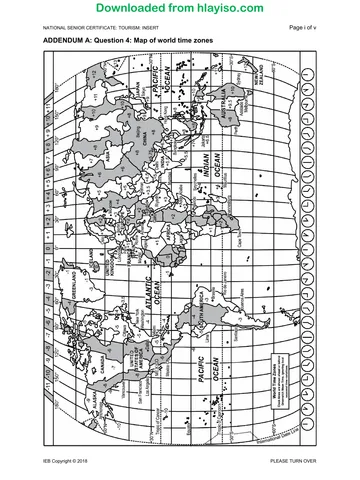
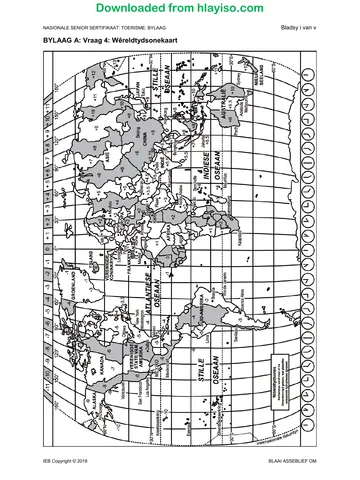
6.1 Daylight savings time is the practice of advancing clocks by 1 hour in
summer and then setting them back by 1 hour in the subsequent winter to
make more productive use of sunlight hours.
6.2 DST makes more productive use of the sunlight hours, it saves on
energy/no need to use lights, health reasons as families are able to spend
more time outside after working hours, fewer accidents on the roads, less
crime as people return home before dark, tourism and leisure businesses
are able to operate longer hours therefore more income/profit, job creation
as people are able to work shifts, lower carbon footprint.
(Any 4 good points)
6.3 Jet lag: when travellers suffer disorientation, nausea, tiredness, swollen feet
as a result of crossing over many time zones (3 and more) when flying to
their destinations.
Jet fatigue: when travellers suffer tiredness and swelling of feet on long-
haul flights (many hours of flying), and only crossed 1–3 time zones.
6.4 This is an imaginary line that runs vertically around the globe also called
The International Date Line. This line marks the start of a new day (when
crossing from west to east the tourist gains a day, date changes back to
previous day).
6.5 6.5.1 Los Angeles is at –8, SA at +2, 10 hours difference 21:00 – 10 hrs =
11:00 day 28 July
6.5.2 No, it is daytime in LA.
6.6 London is at 0 +1 (DST applies) SA is at +2, 1 hour difference. Departure is
at 17:30 local time, = 18:30 in SA, + 9 hour flight = 18:30 + 9 = 03:30 am on
21 June the next day.
IEB Copyright © 2019 PLEASE TURN OVER
Downloaded from hlayiso.com
NATIONAL SENIOR CERTIFICATE: TOURISM – MARKING GUIDELINES Page 11 of 12
QUESTION 7
Refer to the Rubric.
Different needs of customers
Cultural and religious difference, age difference, physical disabilities and
accessibility, understand the target market, different types, wheelchair friendly,
translator for different languages, internet and Wi-Fi connection for business
people, different food types for religious and cultural or dietary reasons.
Expectations – value for money, excellent service, courteous and well-mannered
staff, consideration and consistency.
Importance of customer feedback and methods to measure customer
satisfaction
Advance warning of problem areas so that these can be rectified; retain customers
to ensure repeat business and good word of mouth; external performance feedback
where performance can be improved generally helps to create a better business
and to be sustainable; competitive edge or a unique selling point.
Surveys, questionnaires, feedback cards, follow-up calls, SMS messages, web-based
responses, visitors' books, suggestion boxes, mystery customers, focus groups.
Strategies to achieve and maintain quality service
Ongoing staff training, offer staff incentives to maintain top performance, effective code
of conduct, identify problem areas and put plan of action into place to improve, turn
negative feedback into positive feedback, analyse customer feedback, quality control
checks, peer evaluations, performance evaluation and management.
Recommendations to improve service delivery with reference to factors that
contribute to the success of an attraction
Ensure good environmental practices, responsibility to the local communities,
support local products and services, maintain good marketing techniques, have a
TBL approach to the business, ensuring efficient and ethical behaviour of staff,
maintenance and upkeep of the facility to improve physical appearance,
considering the needs of people with disabilities and improving universal access.
How service in one sector impacts on service in other sectors
Poor service has a knock-on effect/negative multiplier effect, e.g. if a business is
not doing well it could eventually close down, resulting in the supply chain to this
business also losing revenue and so the effect moves on throughout the tourism
industry. A bad experience in one sector will lead to the entire chain receiving a
poor reputation, loss of business and possible closure. Negative word-of-mouth
will impact economy negatively.
How tourism impacts on economic growth of the country
Good word of mouth ensures increased sales and repeat business, customer
loyalty, enhanced public image equals an established name, strive for well-trained
and motivated/effective staff, quality service can also reduce the need for
continuous expensive marketing cost.
IEB Copyright © 2019 PLEASE TURN OVER
Downloaded from hlayiso.com
NATIONAL SENIOR CERTIFICATE: TOURISM – MARKING GUIDELINES Page 12 of 12
QUESTION 8
Refer to the Rubric.
Cleary state and explain the nature of the IRT.
A clear and concise description and explanation is required. The business must be
a legitimate business or mimic the tourism industry.
Discuss your role/contribution in the team.
Student specific – the candidate must clearly state the actual role he/she played in
the team by describing the duties performed.
Evaluate your own strengths and weaknesses and how this effected the
overall performance of the team.
Own strengths and weaknesses need to be discussed but student must analyse how
these affected the overall performance of the team in delivering effective service. The
analysis must be reflective of an actual scenario, honest and critical.
Explain the importance of teamwork in providing a quality service.
Good word of mouth, repeat business, repeat customers, increased profits, long-
term sustainability for the business/service/venture.
Analyse the sustainability and responsibility of this venture.
Positive points: mention sustainable practices and responsibility towards local
community, student specific. Candidate must refer to actual aspects of the
business that are responsible practices, such as whether the business engages in
CSI or CRS, outreach activities, participating in social/community development.
Candidate should also refer to green practices the business has adopted, such as
recycling, re-use, composting, solar energy, supporting local suppliers.
Negative points: identifying any gaps in the sustainable/responsible management
plans.
Illustrate how the multiplier effect impacts the local community.
Refer to both long-term and short-term benefits for local community. An increase
in the demand for goods/services supplied by this venture would lead to a
necessity to meet these demands. This would lead to job creation, an increased
turnover, job security, entrepreneurial opportunities, contribution of the venture to
GDP, infrastructure development. Other economic sectors that would benefit may
be retail (e.g. Pick n Pay), manufacturing, (e.g. furniture), textile industries (e.g.
linen, clothing), transport (e.g. shuttles, taxis, car rentals), tertiary sectors such as
banking, medical support, educational institutions, security organisations,
agricultural industries (farming), telecommunications and technology; municipal
services (such as sewerage and garbage removal). The informal economic sectors
may also benefit, such as crafts and souvenirs made by local unemployed people,
car washers and car guards, local tour guides. All these economic sectors create
linkages, generate income, pay tax and therefore benefit the local economy and
community.
Total: 200 marks
IEB Copyright © 2019
Study this subject
Revise the topics in this paper, then practise them question by question.
- Grade 12 Tourism notes
CAPS revision notes with worked examples.
- Tourism questions by topic
Past exam questions sorted by CAPS topic, with memos where available.
- Grade 12 Tourism quizzes
Short topic quizzes with instant feedback.
- All Grade 12 Tourism past papers
Past papers by year, with memos where available.
- Grade 12 IEB past papers
More Tourism and other subjects in this collection.
Recommended for this subject
More papers and memos for this grade and subject.
Related documents
AddendumIEB
Tourism Grade 12 IEB 2019 Addendum (Afrikaans)
Question paperIEB
Tourism Grade 12 IEB 2019 Question Paper
Question paperIEB
Tourism Grade 12 IEB 2019 Question Paper (Afrikaans)
AddendumIEB
Tourism Grade 12 IEB 2018 Addendum
AddendumIEB
Tourism Grade 12 IEB 2018 Addendum (Afrikaans)
Question paperIEB