Downloaded from hlayiso.com
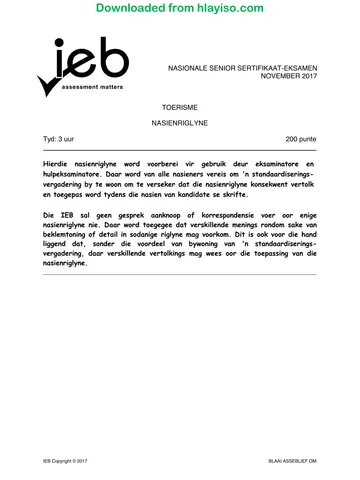
NATIONAL SENIOR CERTIFICATE EXAMINATION
NOVEMBER 2017
TOURISM
MARKING GUIDELINES
Time: 3 hours 200 marks
These marking guidelines are prepared for use by examiners and sub-examiners,
all of whom are required to attend a standardisation meeting to ensure that the
guidelines are consistently interpreted and applied in the marking of candidates'
scripts.
The IEB will not enter into any discussions or correspondence about any marking
guidelines. It is acknowledged that there may be different views about some
matters of emphasis or detail in the guidelines. It is also recognised that,
without the benefit of attendance at a standardisation meeting, there may be
different interpretations of the application of the marking guidelines.
IEB Copyright © 2017 PLEASE TURN OVER
Skip to contentMemorandum 
View all
Tourism Grade 12 IEB 2017 Memo
IEB Grade 12 Tourism memorandum from the 2017, 12 pages. Read online or get the free PDF download, question paper linked when available.
Publisher: IEB
Tourism · Grade 12 · 2017. Memorandum, 12 pages. Read online or download the PDF.
- Subject
- Tourism
- Grade
- Grade 12
- Document type
- Memorandum
- Year
- 2017
- Publisher
- IEB
- Curriculum
- IEB
- Pages
- 12
- File size
- 557.1 KB
Loading document…
Loading document…
1 of 12
Document textSearch extracted text and jump to a page.
Downloaded from hlayiso.com
NATIONAL SENIOR CERTIFICATE: TOURISM – MARKING GUIDELINES Page 2 of 12
QUESTION 1
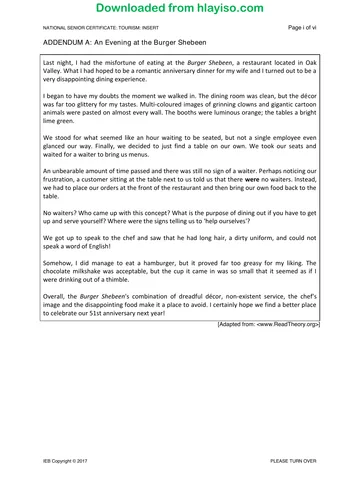
1.1 Physical appearance – bright colours, unsettling atmosphere,
inappropriate décor.
Service – there wasn't any.
Staff communication skills – chef was unable to communicate with the
customers.
Grooming – the chef's hair was dirty, his nails were long.
1.2 Physical appearance – of the business, décor, lighting, colours needed to
be more welcoming, less gaudy.
Service – there wasn't any. No communication to the effect that customers
needed to serve themselves was in evidence. There should have been
signs posted to that effect.
Staff communication skills – chef needed to be able to communicate with
the customers to reduce the possibility of misunderstandings.
Grooming – hair neat and tied up, nails clean and short.
1.3 Benefits of customer complaints: customer complaint can become very
profitable when you can resolve their problem; a customer complaint
highlights problems with employees or internal processes and you can fix
them before further problems arise and cause a bad customer experience;
You can use positive feedback to provide social proofing and attract new
customers; You can use negative feedback to fix any internal processes
and make your customers happy; complaints make you aware of what the
customers want and aren't getting; can give you a competitive advantage.
Business becomes sustainable, customer feels validated and that his/her
opinion is valued.
1.4 Surveys – detailed, personal touch;
Questionnaires – customer can provide detailed suggestions;
Follow-up calls – quick, less personal, more likely to be honest;
Feedback cards – short, only take a few minutes of time;
SMS messaging – impersonal and easy to respond to, also quick;
Web-based responses – personal touch, customer sees the value of their
contribution, feels they have made a difference, no cost involved, paperless;
Mystery customers – anonymous client, staff don't know and won't
pretend to be on best behaviour, an accurate idea of the type of service
rendered is gained, honest and detailed;
Suggestion boxes – anonymous, easily displayed.
Face-to-face questioning by owner or floor manager – this is a personal
touch and issues can be dealt with immediately, customer feels values and
his/opinion matters.
Visitors' book/comment book – easily displayed, future customer can
read comments, can be filled in upon departure.
IEB Copyright © 2017 PLEASE TURN OVER
Downloaded from hlayiso.com
NATIONAL SENIOR CERTIFICATE: TOURISM – MARKING GUIDELINES Page 3 of 12
1.5 Excellent marketing, locally and internationally (learner can mention the P's
of marketing, but this only counts for one point); efficient and ethical
behaviour of staff and management; safety and crime prevention; general
appearance and upkeep; considering the needs of disabled people;
universal access, positive experience of visitors.
Additional points that are acceptable:
Adaptability in a changing market
Employee attitude and buy-in
Technology utilisation
Global footprint, i.e. connectivity, communication, networking
Teamwork
Location
An excellent business plan
Capital for start-up
IEB Copyright © 2017 PLEASE TURN OVER
Downloaded from hlayiso.com
NATIONAL SENIOR CERTIFICATE: TOURISM – MARKING GUIDELINES Page 4 of 12
QUESTION 2
2.1 This means giving back to the local community and the natural environment
(fauna and flora) instead of exploiting them for the purposes of making a
profit.
2.2 This is tourism which:
minimises negative social, economic and environmental impacts and
maximizing positive impacts
generates greater economic benefits for local people and enhances the
well-being of host communities
improves working conditions and access to the industry
involves local people in decisions that affect their lives and life chances
makes positive contributions to the conservation of natural and cultural
heritage, embracing diversity
provides more enjoyable experiences for tourists through more
meaningful connections with local people, and a greater understanding
of local cultural, social and environmental issues
provides access for physically challenged people
is culturally sensitive, encourages respect between tourists and hosts,
and builds local pride and confidence
2.3 The final statement claims that tourism is becoming sustainable and
responsible. The examples below support this statement as businesses in
the industry are aiming to:
Know if their contribution in tourism benefits the local communities as
well as the flora and fauna (community and environment)
Tourism businesses are sourcing as many of their products locally as
possible (community and economic – reducing costs)
Hiring local workers. (community)
Many hotels are offering the option to buy a tree that is planted at the
destination to offset their travel carbon footprint. (environment)
This year we see many solar powered camps in the market. (economic,
saving money and environmental)
Their sewage purity system reduces contamination. (environmental)
The use of social media and online booking systems. (environmental
and economic, saving money)
Meeting locals, experiencing food and cultures
Allowing animals to roam freely and come to them, instead of disturbing
the animals
IEB Copyright © 2017 PLEASE TURN OVER
Downloaded from hlayiso.com
NATIONAL SENIOR CERTIFICATE: TOURISM – MARKING GUIDELINES Page 5 of 12
2.4 strain on already scarce resources such as water, energy, food and
natural habitat areas
may lead to soil erosion, increased pollution and waste, discharges into
the sea and waterways
increased pressure on endangered species of animals and plants
heightened vulnerability to deforestation, as well as loss of biodiversity
mass tourism may also erode traditional values by introducing foreign
elements which are in conflict with the cultural, historical, and religious
heritage of the community (cultural dilution)
cultural misunderstandings
overcrowding
increased prices cause locals to be under financial strain
tourism is seasonal; the benefits are seasonal, jobs are seasonal and
low paid
damage to infrastructure, e.g. roads
2.5 Learner generates own answers, it must be evident that he/she has
researched this career path.
2.6 2.6.1 Code of Conduct
2.6.2 Public has more faith in a business that imposes rules on its staff to
ensure ethical behaviour. The business is seen as caring about its
image and thus its customers. More faith in a business that
encourages collaboration, co-operation and has integrity.
2.7 Helps them make ethical decisions when faced with a dilemma; all
employees are working toward the same goals; have a clear idea of what is
acceptable and not acceptable; support the mission and aims of the
organisation; employees have a clear understanding of what duties are and
what behaviour is expected of them; eliminates misunderstandings and
confusion.
IEB Copyright © 2017 PLEASE TURN OVER
Downloaded from hlayiso.com
NATIONAL SENIOR CERTIFICATE: TOURISM – MARKING GUIDELINES Page 6 of 12
QUESTION 3
3.1 The benefits of teamwork to the team itself include: the sharing of
responsibilities which gets the task done in less time; each team member
can focus on his/her strengths to the benefit of the task, reduces conflict,
builds a sense of camaraderie, shared sense of purpose and success when
aims are achieved. A group needs to have the same goal or mission in
mind, so that all are trying their best to reach that one goal. Good teamwork
leads to efficient service, good communication, a positive reputation and
increase visitor volumes, increased profits. The goals of the organisation
will be achieved more efficiently and the needs and expectations of the
customers will be met. This will give the business a more professional
image and lead to positive word of mouth, repeat visitors, increases in
numbers of visitors and more profit. This also leads to more bookings made,
more contribution to GDP and many more economic benefits.
3.2 Performing stage: "With group norms and roles established, group
members focus on achieving common goals, often reaching an
unexpectedly high level of success" Solving problems, co-operation,
individual tasks are accomplished, conflicts are handled constructively
3.3 Adjourning (or mourning) (also known as 'Breaking up' and 'Reintegration',
according to different teamwork models in the industry.)
3.4 Storming
3.5 3.5.1 Description of each member's tasks, what they were required to do,
name of the type of business (e.g. restaurant, conservation
organisation, spa)
3.5.2 Description of the team goal, honest, sounding credible. Must be a
task performed in the service tourism industry.
3.6 Evaluation must be honest, strengths AND weaknesses must be
mentioned.
IEB Copyright © 2017 PLEASE TURN OVER
Downloaded from hlayiso.com
NATIONAL SENIOR CERTIFICATE: TOURISM – MARKING GUIDELINES Page 7 of 12
QUESTION 4
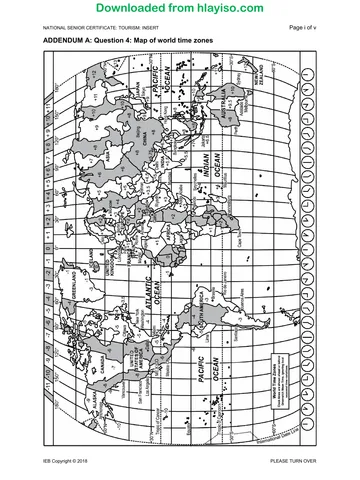
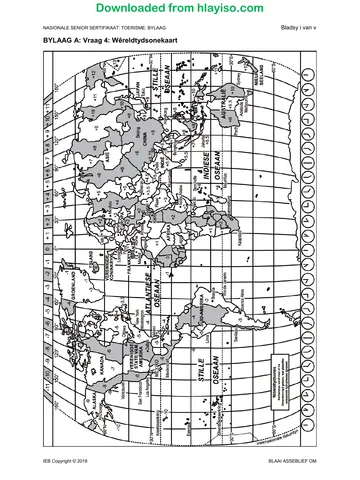
4.1 4.1.1 Miami is at –5
08:00 – 4 hours = arrival at 04:00 a.m. 16 May.
04:00 a.m. – 12 hours flight = 16:00 p.m. 15 May (SA time)
SA is at +2, Miami is at –5, 7 hours difference. (If the candidate
knows that Miami practises DST, he/she must be awarded a mark for
saying that Miami is at –4 and the answer would be an hour
difference)
16:00 – 7 hrs = 09:00 a.m. on 15 May 2017
4.1.2 Arrival at 04:00 a.m. 16 May 2017
SA is at +2, Moscow is at +3 = 1 hour difference. 04:00 a.m. in SA
will be 05:00 a.m. in Moscow. If candidates said that Moscow is at
+4, this can be accepted as the map had no points to indicate
position of cities. Therefore the answer can be 6 a.m. in Moscow.
4.1.3 No, It is winter in the southern hemisphere and DST will not be used.
OR South Africa does not implement DST.
4.1.4 Make more productive use of daylight hours, save electricity, less
pollution, fewer road accidents, fewer pedestrian accidents, more
leisure time spent with family in daylight hours, drop in crime rates,
people stay out for longer, spend more money, which leads to an
economic boost.
.
4.2 Yes they have flown over more than 3 time zones.
4.3 4.3.1 Hep A and B vaccinations, bring own water or buy bottled
water. (NOT Yellow Fever.) Practice safe sex to prevent HIV, also
malaria and cholera.
4.3.2 Keep valuables out of sight, keep away from known high crime
areas, always travel in groups, keep copies of travel documents on
record.
4.3.3 Any 2 of the following can be mentioned: Respect the local people,
ask permission to take photos; try to buy local products that support
local businesses and sample the local cuisine; do not buy artefacts
made from endangered plant or animal material; use local public
transport or hire a bicycle or walk; do not waste valuable natural
resources such as water and electricity; support businesses that
make use of eco products such as solar power or Fair Trade
products; try to learn a few words in local language; don't request
room and towels to be cleaned every day, shower instead of bath.
IEB Copyright © 2017 PLEASE TURN OVER
Downloaded from hlayiso.com
NATIONAL SENIOR CERTIFICATE: TOURISM – MARKING GUIDELINES Page 8 of 12
4.4 DST is implemented in countries that don't get a lot of daylight hours in
summer. SA experiences many hours of sunlight – enough that we don't
have to move the clock forward as the sun rises very early and sets late. NB
the candidate must indicate that there are more hours of sunlight, NOT
more hours in the day or a longer day.
An acceptable response may be marked correct with the discretion of the
marker. There are many answers candidates may come up with.
4.5 When people travel they will have to wake up and go to sleep at different
times which can mess your body clock up
Jet lag: your body clock is not synchronised and therefore causes you to
become fatigued and this may last for several days.
If a traveller crosses the IDL they will be gaining a day (going back to the
previous day).
A tourist has to factor in the time zone of the destination when making
plans or arrangements. The local time at destination may be different
from the time zone at place of departure. The duration of the flight will
then be added to the local time at destination.
QUESTION 5 CONCEPT MAP
5.1 Cyclones are natural disasters, or unforeseen events.
Impact of this event is negative:
Impacts include storms and floods, high winds causing damage, storm
surge on the coastline will mean that coastal resorts are in danger of
flooding and water damage
The threat of danger may lead to tourists cancelling trips or cutting trips
short
This may lead to loss of income and foreign exchange from tourism
Businesses may lose revenue; prolonged losses can lead to job losses
as the demand for goods and services drops
Some smaller businesses may even have to close down
Damage to resorts, roads and other infrastructure may lead to huge
costs incurred for repairs
Some tourism resorts may have to close for renovations to ensure safety
of tourists, leading to severe loss of revenue
Possible loss of life leads to tourists staying away in future rainy
seasons
The Kruger Park experiencing flooding may lead to death of animals, a
natural attraction. (any valid negative points).
Positive: much needed rainfall to a drought stricken area will lead to
growth and development in future
Lack of tourism may give the area an opportunity to recover from
damage
Less tourism means fewer resources are used
Lower prices may mean locals can afford to travel to the area, less
overcrowding, less pollution, less dilution of culture
(any valid positive points)
IEB Copyright © 2017 PLEASE TURN OVER
Downloaded from hlayiso.com
NATIONAL SENIOR CERTIFICATE: TOURISM – MARKING GUIDELINES Page 9 of 12
5.2 Impact on social:
Negative points:
Roofs blown off houses and businesses
Overhead electricity and telephone cables damaged and trees uprooted
Damage to infrastructure incurs costs to repair
Loss of life causes loss of possible breadwinners for families who may
need welfare and assistance
Medical emergencies are also costly
Flooding may lead to cholera outbreaks as sewerage systems fail
Evacuation of people leads to possibility of homelessness
(any valid negative points)
Positive:
As for impact on tourism (any valid positive points – but no repetition)
Impact on environment:
Negative:
Overflowing rivers causes erosion
Washing away of topsoil and agricultural losses
Kruger Park flooding: loss of natural habitat
Death of animals
Damage to coastlines, destruction of beaches (any valid negative points)
Positive:
Less pollution and drain on resources (any valid positive points)
Impact on economy:
Loss of earning potential if people are injured or killed
Drop in tourism causes drop in contribution to GDP
Unemployment levels rising leads to poverty and homelessness
Drain on economic resources if reparations are very costly
Cost of maintenance of damaged infrastructure
Threat of having to import food staples if food sources are destroyed
(agriculture)
Health risks increase drain on public health and welfare services
No positive economic impacts are foreseen (any valid positive points)
5.3 Links must show relationships between concepts.
5.4 Key and colours used.
Refer to the Marking Rubric in the Insert marked Addendum D to
assess this answer.
List the possible responses for the Concept Map and Essay.
IEB Copyright © 2017 PLEASE TURN OVER
Downloaded from hlayiso.com
NATIONAL SENIOR CERTIFICATE: TOURISM – MARKING GUIDELINES Page 10 of 12
QUESTION 6
6.1 Europe – although the Rand is weaker than both currencies, the Rand will
be worth slightly more in Europe, whereas the rand is much weaker to the
Pound. This means that SA tourists will have slightly more buying power in
Europe than in England.
6.2 Mauritius as one Rupee will only cost 37 cents, cheaper than Seychelles,
Botswana or Namibia.
6.3 R50 000 divided by 12,96 = USD 3858,02
6.4 ZAR 2 400 divided by USD 200 = 12. The rate of exchange for USD is now
ZAR12, which means that the Rand has strengthened to the USD.
QUESTION 7:
7.1 7.1.1 Above the line Below the line
7.1.2 Above the line advantages: can reach a large target market,
improves brand recognition, customers can think about their options,
not have to make decision immediately, available 24/7.
Disadvantages – very costly, impersonal.
Below the line advantages – more personal, select target market, can
direct marketing at a specific target group, cheaper form of
marketing. Disadvantages – reaches fewer people, usually people
driven so need staff to be available, not available all the time, relies
on direct contact so opportunities may be lost if no contact between
seller and customer is made. (If candidate has provided one
advantage and one disadvantage of each type, he/she will get 4 full
marks. If candidate gave 2 advantages and 2 disadvantages of either
below the line OR 2 advantages and 2 disadvantages of above the
line, they will be given 4 full marks. As long as they have shown their
understanding of the positive and negative aspects of each type.)
7.1.3 Above: Television, Radio, Newspapers/print, Cinema/Theatres
(product placements), out of home media. (any 1)
Below: pamphlets, brochures, door to door sales, sales promotions,
sponsorships, expos, exhibitions (any 1)
7.2 Travellers can 'see' the product and availability before arriving at the
destination, can make more informed choices, can be more selective and
gather far more information about the product and destination before
arriving, preparation is minimised as it occurs online.
IEB Copyright © 2017 PLEASE TURN OVER
Downloaded from hlayiso.com
NATIONAL SENIOR CERTIFICATE: TOURISM – MARKING GUIDELINES Page 11 of 12
7.3 7.3.1 South African Tourism. ('TOMSA' can be accepted as the question
asks for the name of the 'organisation' that collects this levy and
many teachers teach that TOMSA collects the levy and SAT makes
use of the funds).
7.3.2 Increase tourism marketing for SA both domestically and internationally,
increase product platform, remove obstacles to tourism, maintain
standards in tourism in SA comparable to international standards, co-
ordinate all the role players in tourism.
7.3.3 The money collected is used to fund marketing activities for SA
internationally, improve Brand SA.
7.4 7.4.1 Marketing research, travel costs, communication costs, personnel
costs. Advertising, printing costs, web design
7.4.2 Planning is very important as you need to research whether there is
a need or demand for the product, you need to establish what people
will pay for the product, who your target market will be, what it will
cost to produce. Without researching the mix, you may lose a lot of
money, produce a product that is not wanted, be in the wrong area,
charge too much for it or too little, not make a profit.
7.4.3 Learner's own choice of 2 of the 7/8 P's of marketing with a valid
reason for the choice. Product, price, promotion, people, (this factor
can also include the staffing for the venture, as per Business Studies)
place, packaging/physical evidence, process; partnering.
QUESTION 8 ESSAY
8.2 The definition of the multiplier effect is when money spent by tourists
filters down through different sectors and sub-sectors and industries in the
economy and benefits different organisations and the local community.
8.3 Excellent service is when actions performed for the benefit of customers
exceeds their expectations, not merely meeting their needs but even going
to the point of anticipating needs and going that extra mile to make
customers happy.
Poor service occurs when customers do not receive value for money,
needs are not met and customers are disgruntled and angry.
8.4 Improving the quality of services and the level of customer satisfaction
will create loyal visitors.
Loyal visitors will return to the destination and recommend it to others,
whereas service failure can have devastating effects on an organisation
because customers frequently switch to a different provider when they
experience a service failure.
Customers whose problems are resolved are more likely to remain loyal
to the service provider. (any valid points made)
IEB Copyright © 2017 PLEASE TURN OVER
Downloaded from hlayiso.com
NATIONAL SENIOR CERTIFICATE: TOURISM – MARKING GUIDELINES Page 12 of 12
8.5 In tourism, visitors from foreign countries (and domestic tourists) spend their
money on transport, accommodation, visiting attractions and engaging in
activities.
If the service they receive at these various places is good, or excellent,
then their travel experience is a positive one and these tourists will,
more than likely, return at a later date (repeat visitation)
and will probably also tell many others (positive word of mouth) about
their fantastic holiday.
This may result in increased tourist volume to these attractions. Tourist
spend in the Transport, Hospitality and Attractions sectors will then also
increase.
Contribution to the country's GDP will increase and the country's
economy will benefit. (economic growth)
Tourism ventures (hotels, restaurants, resorts, transport) will receive
more income from this increased tourism volume and spending.
The demand for goods and services goes up, therefore the ventures
need to procure (buy) more goods and employ more staff.
If the ventures employ local people and buy locally produced goods,
then the money circulates within the local community and benefits the
local community.
This is called a linkage.
The staff employed in this venture, are paid with money from the income
from tourists.
The staff's standard of living improves because they have employment,
they are able to buy more food, other goods and services.
Once again, the demand goes up and the local businesses must supply
this demand.
In this way, more employment is created, more money is circulated in all
businesses in the community and, ideally, everyone benefits. (community
development)
8.6 Strategies to achieve and maintain excellent service:
quality control checks,
performance management,
customer surveys,
team and peer reviews,
in-service training,
staff bonuses and incentives.
Use the rubric marked Addendum E to mark this question.
NB if candidate has included sub-headings in the essay in addition to the
numbering, this will be acceptable but the format must reflect an essay. If
there is no essay and only paragraphs against numbers, the candidate has
not followed instructions for answering an essay and should receive a 0
(zero) mark for 'Organisation and mechanics'.
Total: 200 marks
IEB Copyright © 2017
Study this subject
Revise the topics in this paper, then practise them question by question.
- Grade 12 Tourism notes
CAPS revision notes with worked examples.
- Tourism questions by topic
Past exam questions sorted by CAPS topic, with memos where available.
- Grade 12 Tourism quizzes
Short topic quizzes with instant feedback.
- All Grade 12 Tourism past papers
Past papers by year, with memos where available.
- Grade 12 IEB past papers
More Tourism and other subjects in this collection.
Recommended for this subject
More papers and memos for this grade and subject.
Related documents
Question paperIEB
Tourism Grade 12 IEB 2017 Question Paper
Question paperIEB
Tourism Grade 12 IEB 2017 Question Paper (Afrikaans)
AddendumIEB
Tourism Grade 12 IEB 2017 Addendum
AddendumIEB
Tourism Grade 12 IEB 2017 Addendum (Afrikaans)
AddendumIEB
Tourism Grade 12 IEB 2019 Addendum (Afrikaans)
Question paperIEB