
Downloaded from hlayiso.com
NATIONAL
SENIOR CERTIFICATE
GRADE 11
NOVEMBER 2022
CIVIL TECHNOLOGY: CONSTRUCTION
MARKING GUIDELINE
(EXEMPLAR)
MARKS: 200
This marking guideline consist of 16 pages including 1 answer sheet.
Skip to contentAll 2022 papers 
View all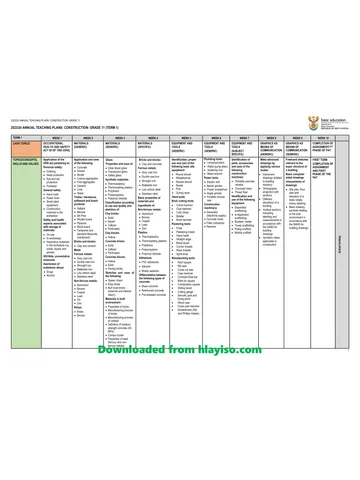
Civil Technology Grade 11 Exemplar November 2022 Memo (Eng)
Grade 11 Civil Technology memorandum from the Exemplar November Exam 2022 (English), 16 pages. Read online or download the free PDF.
Civil Technology · Grade 11 · Exemplar November Exam · 2022 · English. Memorandum, 16 pages. Read online or download the PDF.
- Subject
- Civil Technology
- Grade
- Grade 11
- Language
- English
- Document type
- Memorandum
- Year
- 2022
- Exam period
- Exemplar November Exam
- Curriculum
- CAPS
- Pages
- 16
- File size
- 679.6 KB
Free to read online, no sign-up needed
Loading document…
Loading document…
1 of 16
This exam
Exemplar November Exam 2022
Document textSearch extracted text and jump to a page.
Downloaded from hlayiso.com
2 CIVIL TECHNOLOGY: CONSTRUCTION (EC/NOVEMBER 2022)
INSTRUCTIONS FOR THE MARKERS
1. Markers should:
• Familiarise themselves with the question and answer before evaluating the
responses of candidates.
• Always interpret the responses of the candidates within the context of the
question.
• Consider any relevant and acceptable answer during pre-marking but
should strictly adhere to the answers after finalisation of the marking
guideline.
• There are two approaches to answering questions, these are (1) to
describe and (2) to explain.
• If a candidate is required to explain e.g., a process in 4 steps, only the first
4 responses should be considered.
• If, however a candidate is required to e.g., explain or describe how to
transfer heights from one point to another using a transparent pipe level
we need to consider that candidates may write a long description not
necessarily well organised as an intellectual response may do. In this case
the marker needs to evaluate the complete statement to judge if the
candidate explained the required outcome satisfactorily and allocate
marks on merit. The marker should apply his/her professional judgement
with these types of questions.
• Mark what the candidate wrote and do not award marks for answers that
the marker thinks the candidate meant with what was written.
• Indicate the tick or cross right at the position where the mark needs to be
awarded or where the candidate made the error.
• Accept the letter corresponding with the correct answer as well as the
answer written in full in multiple-choice questions.
• Accept incorrect spelling in one-word answers unless the spelling changes
the meaning of the answer.
2. For calculations:
• A mark is only awarded if the correct unit is written next to the answer.
• If TWO marks are awarded ONE mark is awarded for the answer and
ONE mark for the correct unit.
• Where the candidate made a principle error e.g. added instead of
multiplying, no marks will be awarded for the steps. If the answer is correct
according to what the candidate did, the mark for the answer can be
awarded for the application of skills.
• Where an incorrect answer could be carried over to the next step, the first
answer will be deemed incorrect. However, should the incorrect answer be
carried over correctly, the marker has to recalculate the values, using the
incorrect answer from the first calculation. If correctly used, the candidate
should receive the full marks for subsequent calculations.
• Markers should consider when and where a candidate has rounded off in
a calculation, as well as the subsequent effect it has on the final answer
obtained. The calculation should therefore be awarded marks on merit.
• Alternative methods of calculations must be considered, provided that the
correct answer is obtained.
Copyright reserved Please turn over
Downloaded from hlayiso.com
(EC/NOVEMBER 2022) CIVIL TECHNOLOGY: CONSTRUCTION 3
3. When marking drawings:
• The member for which the mark should be awarded should be drawn
correctly in the correct position to receive a mark.
• A member incorrectly drawn but wrongfully repeated in another position
will be awarded the mark for the repeated incorrect member provided that
the marking guideline provide for TWO or more marks for that member
(positive marking).
• Marks can only be awarded for a label if the label is correctly indicating the
correct member.
• Scale drawings should always be marked using an appropriate mask.
When a candidate drew the wrong drawing e.g.:
• A horizontal section instead of a vertical section, no marks will be
allocated to the drawing as the candidate did not respond to the expected
outcome.
• An orthographic view instead of sectional view, no marks will be allocated
to the drawing as the candidate did not respond to the expected outcome.
• An orthographic view instead of an isometric view, no marks will be
allocated to the drawing as the candidate did not respond to the expected
outcome.
• If the incorrect drawing was drawn, the candidate can be awarded for only
what was asked but mark/s for the correctness of the drawing will not be
awarded e.g., if a King Post roof truss was asked in the question, and
candidate drew SA-Howe Truss.
Copyright reserved Please turn over
Downloaded from hlayiso.com
4 CIVIL TECHNOLOGY: CONSTRUCTION (EC/NOVEMBER 2022)
QUESTION 1: SAFETY AND MATERIALS (GENERIC)
1.1 Gum boots (1)
1.2 Under what circumstances will the following personal protective equipment be
used?
1.2.1 Safety glasses
When working with a bench grinder, drills, electrical saws, etc. or any
electrical equipment. (1)
1.2.2 Earplugs
When noise levels are high. (1)
1.3 Loose clothing can be pulled (1) into the machine by its moving parts (1). (2)
1.4 Describe the safety precaution that is applicable with the following hand tools:
1.4.1 Hammer heads
Should fit snugly into the handle and be wedged in properly. (1)
1.4.2 Sawing equipment
Should be sharp and clean / Handles should be properly attached. (1)
1.4.3 When carrying chisels.
Carry the blade facing downwards. (1)
1.5 The petrol fumes can be harmful (1), when inhaled (1).
(Similar answer.) (2)
1.6 Any TWO requirements for the storing of cement:
• Store on a pallet / planks / damp proof course or similar answer.
• Store under cover / inside a building.
• No contact with water. (Any 2 x 1) (2)
1.7 Any ONE similar answer:
• Warning people against overhead work / dangers.
• To show that the wearing of a hard hat is compulsory. (1)
1.8 Any FOUR requirements for storing hazardous material in the workplace:
• The room must be well ventilated.
• The door must have a threshold.
• Material that may cause a spark must not be stored here.
• Liquids that may interact chemically must be stored in close proximity.
• Containers must always be sealed or properly closed.
• Never store other flammable material with hazardous material. (Any 4 x 1) (4)
Copyright reserved Please turn over
Downloaded from hlayiso.com
(EC/NOVEMBER 2022) CIVIL TECHNOLOGY: CONSTRUCTION 5
1.9 THREE ingredients to mix screed:
• Cement (1)
• Sand (1)
• Water (1) (3 x 1) (3)
1.10 Any THREE uses for screed:
• Finish for floors and walls.
• Facing material
• Levelling layer for suspended floors.
• Levelling layer for floor covering.
• Infill to accommodate various levels.
• Insulated roof screed. (Any 3 x 1) (3)
1.11 • Aggregate is too coarse.
• Aggregate too big for a mortar joint.
• Rough parts will give a weak finish.
• Similar answer. (Any 1 x 1) (1)
1.12 Identify the type of board products that will be used for the following work:
1.12.1 Backs of cupboards
Hard board or plywood. (1)
1.12.2 Formwork for concrete
Shutter board (1)
1.13 Stock bricks:
No attractive appearance / Must be plastered / Not good quality (1)
Face bricks:
Attractive appearance / Require no plaster / Good quality (1) (2)
1.14 Any TWO uses of cast iron:
• Manhole covers
• Sewerage pipes and fittings
• Baths
• Wash basins
• Tools
• Hinges
• Similar answer (Any 2 x 1) (2)
[30]
Copyright reserved Please turn over
Downloaded from hlayiso.com
6 CIVIL TECHNOLOGY: CONSTRUCTION (EC/NOVEMBER 2022)
QUESTION 2: EQUIPMENT, TOOLS AND GRAPHICS (GENERIC)
2.1 Round shovel cannot shape the corners / square edges / straight lines (similar
answer). (1)
2.2 Any THREE hand tools that can be used to dress / cut bricks:
• Comb hammer
• Cold chisel
• Bolster
• Club hammer
• Brick hammer (3 x 1) (3)
2.3 2.3.1 Hand hawk (1)
2.3.2 Straight edge (1)
2.3.3 External corner trowel (1)
2.3.4 Nose trowel (1)
2.4 The rip saw is used for cutting with the grain of the wood. (1)
The cross-cut saw is used for cutting across the grain of wood. (1) (2)
2.5 2.5.1 Sliding bevel (1) (1)
Any ONE use:
• Drawing inclined / oblique lines.
• Drawing angles other than 90⁰.
• Copying angles to transfer them to other surfaces. (Any1 x 1) (1)
2.5.2 Bench grinder (1) (1)
Any ONE use:
• Sharpening tools
• Grinding
• Wire brush attachment can be installed. (Any 1 x 1) (1)
2.5.3 Electrical drill (1). (1)
Any ONE use:
• Drilling holes.
• Can be used as a screwdriver.
• Sanding / buffing / cutting accessories attached to drill. (Any 1 x 1) (1)
2.6 2.6.1 Plate compactor (1)
2.6.2 Any ONE use:
• Compacting disturbed or loose soil up to 150 mm.
• Tamping fillings for a hard-core layer under concrete floors.
• Compacting soil before paving bricks are laid.
• Similar answer. (Any 1 x 1) (1)
Copyright reserved Please turn over
Downloaded from hlayiso.com
(EC/NOVEMBER 2022) CIVIL TECHNOLOGY: CONSTRUCTION 7
2.7 See ANSWER SHEET 1. (13)
2.8 Part of the structure is enlarged (1) to include more information to the
drawing (1) (2)
2.9 Any THREE particulars of a site plan:
• Boundaries of property
• Building line
• Erf numbers of plot and adjacent plots
• Services and connections
• Name of street
• Driveway
• Trees / boulders
• Measurements
• Existing buildings
• Contours
• North arrow
• Scale (Any 3 x 1) (3)
2.10 2.10.1 Water closet
(2)
2.10.2 Hot-water cylinder
HW (2)
[40]
Copyright reserved Please turn over
Downloaded from hlayiso.com
8 CIVIL TECHNOLOGY: CONSTRUCTION (EC/NOVEMBER 2022)
QUESTION 3: QUANTITIES, JOINING AND GRAPHICS
3.1 FIGURE 3.1 shows a foundation strip for a building.
The foundation is 600 mm wide and 200 mm thick.
A concrete mix of 1 : 4 : 4 is used.
9 000
6 000
FIGURE 3.1
3.1.1 Determine the centre line of the foundation:
2 x 9 000 = 18 000
2 x 6 000 = 12 000
20 000
4 x 600 - 2 400
17 600 = 17,6 m (5)
3.1.2 Determine the volume of concrete needed:
17,6 x 0,6 x 0,2 = 2,112 m³
3.2 A one brick wall of 1,2 m high and 12 m long.
Determine the amount of bricks needed: (5)
Area of wall:
12
x 1,2 = 14,4 m2
14,4
x 2
x 50 = 1 440 bricks
Copyright reserved Please turn over
Downloaded from hlayiso.com
(EC/NOVEMBER 2022) CIVIL TECHNOLOGY: CONSTRUCTION 9
3.3 Apply a thin layer of PVC glue (1) to the fitting and the pipe. (1)
Push the parts into position (1), while twisting. (1) (4)
3.4 3.4.1 True (1)
3.4.2 False (1)
3.4.3 False (1)
3.4.4 True (1)
3.4.5 True (1)
3.5 Any TWO safety precautions when using epoxy:
• Apply with care – cleaning excess/overruns is difficult once dry.
• Be careful – the fumes may be toxic.
• Join surfaces firmly together, before the compound dry (Any 2 x 1) (2)
3.6
(2)
3.7 Bottom (1) right-hand corner (1) of the drawing page. (2)
3.8 3.8.1 Fluorescent light (1)
3.8.2 Wall light (1)
[30]
Copyright reserved Please turn over
Downloaded from hlayiso.com
10 CIVIL TECHNOLOGY: CONSTRUCTION (EC/NOVEMBER 2022)
QUESTION 4: MATERIAL, EQUIPMENT AND JOINING (SPECIFIC)
4.1 4.1.1 Any ONE use of cellular bricks:
• Brick/cavity walls
• Foundations
• Cellars
• External walls
• Similar answer (1)
4.1.2 25% (1)
4.1.3 Any TWO advantages of cavities in cellular bricks:
• Reduce the amount of clay needed.
• Ensure uniformly shaped bricks.
• Help to resist shrinking.
• Uniform density.
• Improve insulating properties.
• Allow bricks to dry more quickly.
• Makes the brick lighter.
• Reduce the weight of the building.
• Easier to dry and fire the bricks.
• Similar answer. (Any 2 x 1) (2)
4.2 4.2.1 False (1)
4.2.2 False (1)
4.2.3 True (1)
4.3 4.3.1 Keyed brick
4.3.2 Hollow concrete blocks
4.3.3 Concrete paving bricks
4.4 Clay or shale (1) and limestone or chalk (1) (2)
4.5 4.5.1 15 MPa (1)
4.5.2 30 MPa (1)
Copyright reserved Please turn over
Downloaded from hlayiso.com
(EC/NOVEMBER 2022) CIVIL TECHNOLOGY: CONSTRUCTION 11
4.6 4.6.1 Independent scaffolding (1)
4.6.2 A – Guard rail (1)
B – Kickboard (1)
C – Horizontal transoms (1)
D – Vertical standard (1)
E – Baseplate (1) (5)
4.6.3 Any ONE purpose of the kickboard:
• Prevent material from falling off the scaffolding.
• Prevent tools from falling off.
• Prevent workers from slipping and injuries.
• Similar answer. (Any 1 x1) (1)
4.7 4.7.1 Portable concrete vibrator (1)
4.7.2 Power float (1)
4.7.3 Builders trestle (1)
4.8 Any TWO joining methods by using:
• Metal straps
• Fixing lug
• Hoop iron ties
• Nails (Any 2 x 1) (2)
4.9 Any TWO types of wall ties:
• Stainless steel
• Butterfly pattern
• Nylon wall tie
• Twisted pattern
• Double triangle pattern. (Any 2 x 1) (2)
4.10 Stainless steel or nylon or a rust-free / rustproof material. (1)
4.11 Join two brick rows / eaves with each other. (1)
[30]
Copyright reserved Please turn over
Downloaded from hlayiso.com
12 CIVIL TECHNOLOGY: CONSTRUCTION (EC/NOVEMBER 2022)
QUESTION 5: EXCAVATIONS, FOUNDATIONS AND STEEL (SPECIFIC)
5.1 5.1.1 A – Sighting line. (1)
B – Boning rod. (1)
C – Profile board / plank. (1)
5.1.2 150 mm (1)
5.2 5.2.1 D (all heights are determined from this point) (1)
5.2.2 F (cheaper material for formwork) (1)
5.2.3 E (remove 300 mm) (1)
5.2.4 A (expensive material for formwork) (1)
5.2.5 B (most accurate way to test levelness). (1)
5.3 Any TWO methods of dewatering:
• Pumping out water
• Creating drains
• Bailing of water / use buckets to scoop
• Similar answer (mechanical or manually) (Any 2 x 1) (2)
5.4 Any THREE causes of trench accidents:
• Excavated earth on the edge of the trench (sides can collapse).
• Safety precautions for poor soil conditions.
• Buildings, utilities, heavy traffic routes nearby and any source of vibration.
• Previously disturbed ground.
• Proximity of streams, old sewers and underground cables.
• Availability of adequate equipment, protective gear, shoring materials and
warning signs and lights. (Any 3 x 1) (3)
5.5 5.5.1 Block foundation (1)
5.5.2 Steel pipe with casing pile (1)
5.5.3 Wide strip foundation (1)
5.5.4 Franki-pile (1)
5.5.5 Short-bored pile (auger drill) (1)
5.6 Step 1: Drill hole to correct depth (1) (1)
Step 2: Place reinforcing in position in the hole (1) (1)
Step 3: Fill the hole with concrete (1) (1)
Copyright reserved Please turn over
Downloaded from hlayiso.com
(EC/NOVEMBER 2022) CIVIL TECHNOLOGY: CONSTRUCTION 13
5.7 Any THREE advantages of piles:
• Can be used in poor soil.
• Can be used anywhere, even in water.
• Larger base ensures stability.
• Relatively quick and easy to install, if equipment is available.
• If prefabricated piles are used, much time is saved.
• Resists tensile stress well.
• Quick and less expensive to produce.
• Can be manufactured elsewhere beforehand.
• Installation can continue, even in poor weather conditions.
• Length of piles can easily be adjusted, depending on circumstances.
• Offers sound resistance against moving soil. (Any 3 x 1) (3)
5.8 I-beam: the web is longer than the flanges (1) (1)
H-beam: the web and the flanges are the same length (1) (1)
5.9 Angle iron (1)
5.10 5.10.1 H-beam (1)
5.10.2 Angle iron (1)
[30]
Copyright reserved Please turn over
Downloaded from hlayiso.com
14 CIVIL TECHNOLOGY: CONSTRUCTION (EC/NOVEMBER 2022)
QUESTION 6: FORMWORK, BRICKWORK, STAIRS AND QUANTITIES (SPECIFIC)
6.1 Formwork is a temporary mould / structure that contains poured concrete. (1)
and supports until it has hardened and gained strength to support itself. (1) (2)
6.2 Any THREE requirements of good formwork:
• Sturdy enough to bear the mass of wet concrete without collapsing.
• Strong enough to provide sufficient support, without deflection.
• Easy to repair on site.
• Erected accurately.
• Sealed properly – no leaking and forming of honeycombing / fins.
• Free of dirt (sawdust / release agents).
• Quick and simple to erect (hand / mechanical).
• Correct depth for reinforcing – prevent failure.
• Easy to remove.
• Close-fitting along joints and seams.
• Made of recyclable components. (Any 3 x 1) (3)
6.3 6.3.1 Column (1)
6.3.2 A – Yoke (1)
B – Clamp (1)
C – Shutter boards (1)
D – Wedge (1)
6.4 Any TWO reasons for the cover depth of reinforcement in concrete:
• To protect steel against corrosion / rust.
• To provide adequate bonding between the steel and concrete.
• To ensure adequate protection of steel in an event of fire. (Any 2 x 1) (2)
6.5 6.5.1 True (1)
6.5.2 False (1)
6.5.3 True (1)
6.5.4 False (1)
6.6 55 mm (1)
6.7 No (1)
6.8 Where maximum strength is required. (1)
Copyright reserved Please turn over
Downloaded from hlayiso.com
(EC/NOVEMBER 2022) CIVIL TECHNOLOGY: CONSTRUCTION 15
6.9 Any THREE places for DPC in a house:
• Under / sides of concrete floors
• In walls
• At windows
• At doors
• In roofs
• Similar answer. (Any 3 x 1) (3)
6.10 6.10.1 Gauged segmental arch (1)
6.10.2 Stretcher bond (1)
6.10.3 A – Extrados (1)
B – Springer (1)
C – Key brick. (1)
D – Intrados (1)
6.11 6.11.1 Run (1)
6.11.2 Riser (1)
6.12 6.12.1 Perimeter = side + side + side + side
= 2(2,3 m) + 2(1,5 m + 0,44 m)
= 4,6 m + 3, 88 m
= 8,48 m (3)
6.12.2 Area = length x breadth
= (2,3 – 0,22 – 0,22) x 1, 5
= 1,86 m x 1,5 m
= 2,79 m² (3)
6.12.3 Floor skirtings = 2(2,3 m – 0, 44 m) + 1,5 m + (1, 5 m – 0, 9 m)
= 3,72 m + 1,5 m + 0,6 m
= 5,82 m (4)
[40]
TOTAL: 200
Copyright reserved Please turn over
Downloaded from hlayiso.com
16 CIVIL TECHNOLOGY: CONSTRUCTION (EC/NOVEMBER 2022)
CIVIL TECHNOLOGY
ANSWER SHEET 1 CONSTRUCTION
NAME:
2.7 FIGURE 2.7 on ANSWER SHEET 1 shows the isometric view of a
T-junction of a half brick wall in stretcher bond.
Draw the front view of the brick wall on scale 1 : 10. (13)
FIGURE 2.7
T-junction 4
Brick sizes / Scale 3
Height and length 2
Stretcher bond 2
Line work / Neatness 2
TOTAL: 13
Copyright reserved Please turn over
Study this subject
Recommended for this subject
Question paper
Civil Technology Grade 11 Exemplar November 2022 QP (Eng)
Question paper
Civil Technology Grade 11 2022 QP (Eng)
Question paper
Civil Technology Grade 11 2022 QP (Eng)
Memorandum
Civil Technology Grade 11 Eastern Cape November 2019 Memo
Practical assessment task
Civil Technology PAT GR 11 2017 Eng
Memorandum
Civil Technology Grade 11 Eastern Cape November 2020 Memo
More from Grade 11 Civil Technology
Annual teaching plan
Gr 11 Cons ATP 2023 24
Annual teaching plan
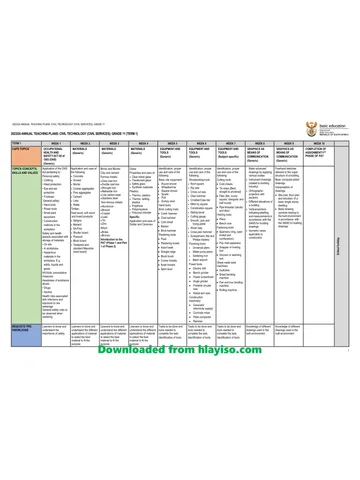
Gr 11 Civil Ser ATP 2023 24
Memorandum
Civil Technology Grade 11 Eastern Cape November 2020 Memo
Memorandum
Civil Technology Grade 11 Eastern Cape November 2020 Memo
Memorandum
Civil Technology Grade 11 Eastern Cape November 2020 Memo
Memorandum