
NATIONAL
SENIOR CERTIFICATE
GRADE 11
NOVEMBER 2025
HISTORY P2
MARKS: 150
TIME: 3 hours
This question paper consists of 9 pages and an addendum of 14 pages.
Skip to contentAll 2025 papers 
View all
History Grade 11 P2 Eastern Cape November 2025 QP (Eng)
Grade 11 History Paper 2 question paper from the Eastern Cape November Exam 2025 (English), 9 pages. Read online or download the free PDF.
History · Grade 11 · Eastern Cape November Exam · 2025. Question paper, 9 pages. Read online or download the PDF.
- Subject
- History
- Grade
- Grade 11
- Document type
- Question paper
- Year
- 2025
- Exam period
- Eastern Cape November Exam
- Paper
- 2
- Curriculum
- CAPS
- Pages
- 9
- File size
- 552.7 KB
Free to read online, no sign-up needed
Loading document…
Loading document…
1 of 9
This exam
Eastern Cape November Exam 2025
Questions in this paper
Document textSearch extracted text and jump to a page.
2 HISTORY P2 (EC/NOVEMBER 2025)
INSTRUCTIONS AND INFORMATION
1. This question paper consists of SECTION A and SECTION B based on the
prescribed content framework in the CAPS document.
SECTION A: SOURCE-BASED QUESTIONS
QUESTION 1: NATIONALISM IN SOUTH AFRICA ‒ AFRICAN
NATIONALISM (1902 to 1940s)
QUESTION 2: NATIONALISM IN SOUTH AFRICA ‒ AFRIKANER
NATIONALISM (1900 to 1930s)
QUESTION 3: APARTHEID SOUTH AFRICA – (1940s to 1960s)
SECTION B: ESSAY QUESTIONS
QUESTION 4: NATIONALISM IN SOUTH AFRICA ‒ AFRICAN
NATIONALISM (1940s to 1950s)
QUESTION 5: NATIONALISM IN SOUTH AFRICA ‒ AFRIKANER
NATIONALISM (1930s to 1940s)
QUESTION 6: APARTHEID SOUTH AFRICA – (1940s to 1960s)
2. SECTION A consists of THREE source-based questions. Source material that
is required to answer these questions may be found in the ADDENDUM.
3. SECTION B consists of THREE essay questions.
4. Answer THREE questions as follow:
4.1 At least ONE must be a source-based question and at least ONE must
be an essay question.
4.2 The THIRD question can either be a source-based question or an essay
question.
5. You are advised to spend at least ONE hour per question.
6. When answering questions, candidates should apply their knowledge, skills and
insight.
7. You will be disadvantaged by merely rewriting the sources as answers.
8. Number the answers correctly according to the numbering system used in this
question paper.
9. Write neatly and legibly.
Copyright reserved Please turn over
(EC/NOVEMBER 2025) HISTORY P2 3
SECTION A: SOURCE-BASED QUESTIONS
Answer at least ONE question in this section. Source material to be used to answer
these questions is contained in the ADDENDUM.
QUESTION 1: HOW DID THE RISE OF AFRICAN NATIONALISM
CONTRIBUTE TO RESISTANCE AGAINST THE UNION OF
SOUTH AFRICA’S SEGREGATION POLICIES FROM 1910 TO
THE 1920s?
Study Sources 1A, 1B, 1C and 1D and answer the questions that follow.
1.1 Refer to Source 1A.
1.1.1 Name any TWO African leaders who were responsible for the
formation of a national organisation. (2 x 1) (2)
1.1.2 Explain the implications that most delegates had received missionary
education, would have on the rise of African nationalism. (2 x 2) (4)
1.1.3. Why, according to the source, did the SANNC change its name to
the African National Congress in 1924? (1 x 2) (2)
1.1.4 Define the term racial injustices in your own words. (1 x 2) (2)
1.2 Consult Source 1B.
1.2.1 Name the location, outside town, where black people had to live.
(1 x 1) (1)
1.2.2. Explain why there was a growing number of the black population
moving into the urban areas. (2 x 2) (4)
1.2.3 Why do you think women decided to protest against the Pass Laws?
(2 x 2) (4)
1.2.4 Comment on the historical significance that the resistance against
the Pass Laws had on the growth of African nationalism. (2 x 2) (4)
1.3 Study Source 1C.
1.3.1 Why do you think this photograph was taken? (2 x 2) (4)
1.3.2 Name TWO impacts that passes had on the lives of black South
Africans. (2 x 1) (2)
Copyright reserved Please turn over
4 HISTORY P2 (EC/NOVEMBER 2025)
1.4 Compare Source 1B and Source 1C. Explain how the information in
Source 1B supports the evidence in Source 1C regarding the reaction of
women to the Pass Laws. (2 x 2) (4)
1.5 Read Source 1D.
1.5.1 What opportunity, according to the source, did beer-brewing
provide women? (2 x 1) (2)
1.5.2 What, according to the source, were the consequences of police
raids? (3 x 1) (3)
1.5.3 Comment on the reasons why women would act militantly against
the canteens. (2 x 2) (4)
1.5.4 Define the term boycott in the context of the implementation of
the Liquor Act. (1 x 2) (2)
1.6 Using the information in the relevant sources and your own knowledge,
write a paragraph of about SIX lines (about 60 words) explaining how the
rise of African nationalism contributed to resistance against the Union of
South Africa’s segregation policies from 1910 to the1920s. (6)
[50]
Copyright reserved Please turn over
(EC/NOVEMBER 2025) HISTORY P2 5
QUESTION 2: HOW DID AFRIKANER NATIONALISM EXPRESS ITSELF
THROUGH VARIOUS ORGANISATIONS IN THE 1930s AND
1940s?
Study Sources 2A, 2B, 2C, and 2D to answer the following questions.
2.1 Study Source 2A.
2.1.1 What, according to the source, aroused Afrikaner nationalism?
(3 x 1) (3)
2.1.2 Define the term Afrikaner Nationalism in the context of the rise of
Afrikaner nationalism. (1 x 2) (2)
2.1.3 Explain why the Afrikaner publicists would elaborately romanticised
a modern version of a minuscule (small) Afrikaner David slaying the
British Goliath, with regard to the rise of Afrikaner nationalism.
(2 x 2) (4)
2.1.4 What, according to the source, was the three-pronged struggle?
(2 x 1) (2)
2.2 Read Source 2B.
2.2.1 Who, according to the source, formed the Society of True
Afrikaners? (1 x 1) (1)
2.2.2 Why do you think the Afrikaners will promote the Afrikaans
language? (2 x 2) (4)
2.2.3 What, according to the source, worsened the resentment between the
Afrikaans speaking people and the English-speaking communities?
(2 x 1) (2)
2.2.4 Define the term scorched earth policy in your own words. (1 x 2) (2)
2.3 Consult Source 2C.
2.3.1 What, according to the source, were the results of the depression of
the early 1930s? (1 x 2) (2)
2.3.2 What occupations did male Afrikaners engage in, according to the
source? (2 x 1) (2)
2.3.3 Comment on what is implied by the statement that the impoverished
Afrikaners had to be rescued for the volk. (2 x 2) (4)
2.3.4 Explain how the implementation of volkskapitalisme enhanced
Afrikaner nationalism. (2 x 2) (4)
Copyright reserved Please turn over
6 HISTORY P2 (EC/NOVEMBER 2025)
2.4 Use Source 2C.
2.4.1 Why do you think this photograph was taken? (2 x 2) (4)
2.4.2 Explain how the government addressed the issue of the poor whites.
(2 x 2) (4)
2.5 Compare Source 2C and Source 2D. Explain how does the information in
Source 2C supports the evidence in Source 2D regarding the role played by
different organisations to improve the lives of poor whites. (2 x 2) (4)
2.6 Using the information in the relevant sources and your own knowledge, write
a paragraph of about SIX lines (about 60 words) explaining how Afrikaner
nationalism expressed itself through various Afrikaner organisations in the
1930s and 1940s. (6)
[50]
Copyright reserved Please turn over
(EC/NOVEMBER 2025) HISTORY P2 7
QUESTION 3: HOW DID THE PAN AFRICANIST CONGRESS (PAC) RESPOND
TO THE APARTHEID GOVERNMMENT’S REPRESSIVE
MEASURES?
Study Sources 3A, 3B, 3C and 3D to answer the following questions.
3.1 Read Source 3A.
3.1.1 Define the term Apartheid in your own words. (1 x 2) (2)
3.1.2 Who, according to the source, was the first president of the Pan
Africanist Congress? (1 x 2) (2)
3.1.3 Explain what is meant by Robert Sobukwe’s leadership of the PAC,
based on a vision of an ‘Africa for Africans’ which promoted mass
action against discrimination. (2 x 2) (4)
3.1.4 Using the source and your knowledge, explain why Robert Sobukwe
was against the policy of multi-racialism. (2 x 2) (4)
3.2 Study Source 3B.
3.2.1 Which suburb, according to the source, was untouched by anti-
apartheid demonstrations? (1 x 2) (2)
3.2.2 Quote evidence from the source that shows that Sobukwe wanted to
reduce the possibility of violence. (1 x 2) (2)
3.2.3 Using the source and your knowledge, comment on the implications of
the campaign slogan: “NO BAIL! NO DEFENCE! NO FINE!” (2 x 2) (4)
3.2.4 Explain what the shooting of people in the back show about the
attitude of the police towards the Sharpeville protesters? (2 x 2) (4)
3.2.5 Explain how useful this source will be to a historian studying the
protest march on 21 March 1960. (2 x 2) (4)
3.3 Refer to Source 3C.
3.3.1 Explain why you think this photograph was taken. (2 x 2) (4)
3.3.2 Why, according to the photograph, were people running? (1 x 1) (1)
3.4 Consult Source 3D.
3.4.1 Who, according to the source, praised the police for their actions?
(1 x 2) (2)
3.4.2 Define the term State of emergency in the context of the Sharpeville
massacre. (1 x 2) (2)
3.4.3 How, according to the source, did the government respond after the
Sharpeville massacre? (3 x 1) (3)
Copyright reserved Please turn over
8 HISTORY P2 (EC/NOVEMBER 2025)
3.4.4 Comment on why the government banned the ANC and PAC under
the Unlawful Organisations Act. (2 x 2) (4)
3.5 Using the information in the relevant sources and your own knowledge, write
a paragraph of about SIX lines (about 60 words) on how the Pan Africanist
Congress (PAC) responded to the apartheid governments repressive
measures. (6)
[50]
Copyright reserved Please turn over
(EC/NOVEMBER 2025) HISTORY P2 9
SECTION B: ESSAY QUESTIONS
Answer at least ONE question, but not more than TWO questions in this section.
QUESTION 4: NATIONALISM IN SOUTH AFRICA ‒ AFRICAN NATIONALISM
Critically discuss how the deprivation of Black South Africans’ political, economic, and
social rights in the early 1900s contributed to the rise of African nationalism in the
1940s to the 1950s.
Use relevant evidence to support your line of argument. [50]
QUESTION 5: NATIONALISM IN SOUTH AFRICA ‒ AFRIKANER NATIONALISM
The desire to preserve Afrikaner cultural identity and political power awakened the
rise of Afrikaner Nationalism in the 1930s to the 1940s.
Do you agree with this statement? Substantiate your answer by referring to the
different forms of cultural and political movements amongst the Afrikaners. [50]
QUESTION 6: APARTHEID SOUTH AFRICA ‒ RESISTANCE IN SOUTH AFRICA
Explain to what extent civil disobedience and non-violent protests by liberation
movements intensified resistance against the apartheid government in the 1950s.
Use relevant evidence to support your line of argument. [50]
TOTAL: 150
Copyright reserved Please turn over
Study this subject
Recommended for this subject
Memorandum
History Grade 11 P2 Eastern Cape November 2025 Memo (Eng)
Memorandum
History Grade 11 P2 Eastern Cape November 2025 Memo (Afr)
Memorandum
History Grade 11 Paper 1 Eastern Cape November 2025 Memo
Question paper and memo
History Grade 11 Paper 2 Eastern Cape June 2025 Paper & Memo
Memorandum
History Grade 11 P2 Eastern Cape November 2024 Memo (Afr)
Addendum
History Grade 11 P2 Eastern Cape November 2023 Addendum
More from Grade 11 History
Memorandum
History Grade 11 Paper 1 November Mock 2026 Memo (English)
Annual teaching plan
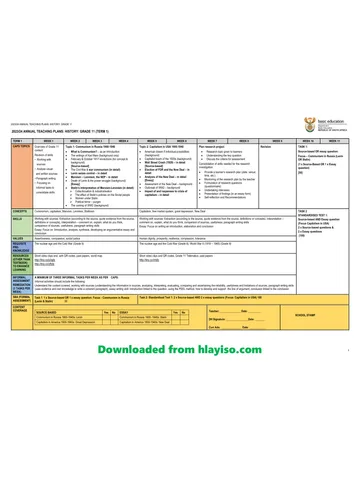
Gr 11 His ATP 2023 24
Question paper
History Grade 11 P1 North West November 2024 QP (Eng)
Question paper
History Grade 11 P2 North West November 2024 QP (Eng)
Memorandum
History Grade 11 P1 Eastern Cape November 2023 Memo (Eng)
Memorandum