
Downloaded from hlayiso.com
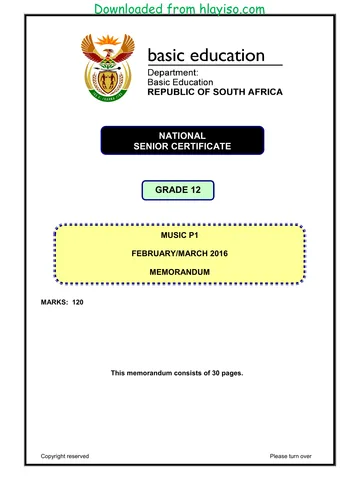
GRAAD 12
NATIONAL
SENIOR CERTIFICATE
GRADE 12
MUSIC P1
NOVEMBER 2016
MEMORANDUM
MARKS: 120
This memorandum consists of 33 pages.
Copyright reserved Please turn over
Skip to contentAll 2016 papers 
View all
Music Grade 12 Paper 1 NSC November 2016 Memo (English)
Grade 12 Music Paper 1 memorandum from the NSC November Exam 2016 (English), 33 pages. Read online or download the free PDF.
Music · Grade 12 · NSC November Exam · 2016. Memorandum, 33 pages. Read online or download the PDF.
- Subject
- Music
- Grade
- Grade 12
- Document type
- Memorandum
- Year
- 2016
- Exam period
- NSC November Exam
- Paper
- 1
- Curriculum
- CAPS
- Pages
- 33
- File size
- 1003.7 KB
Free to read online, no sign-up needed
Loading document…
Loading document…
1 of 33
This exam
NSC November Exam 2016
Questions in this paper
- Question 1Scales, Keys, Modes & Intervals20 marks
- Question 2Harmony, Chords & Composition15 marks
- Question 3Harmony, Chords & Composition20 marks
- Question 4Harmony, Chords & Composition15 marks
- Question 5Notation, Rhythm & Metre20 marks
- Question 6Western Art Music (WAM) — General Knowledge & Set Works [WAM]10 marks
Document textSearch extracted text and jump to a page.
Downloaded from hlayiso.com
Music/P1 2 DBE/November 2016
NSC – Memorandum
INSTRUCTIONS AND INFORMATION
1. This question paper consists of FIVE sections, namely SECTIONS A, B, C, D
and E.
2. SECTIONS A and B are COMPULSORY.
3. SECTION C: WESTERN ART MUSIC (WAM), SECTION D: JAZZ and
SECTION E: INDIGENOUS AFRICAN MUSIC (IAM) are choice questions.
Answer only ONE of these sections (SECTION C or D or E).
4. Write all music notation in SECTION A in pencil and all written text in blue or
black ink on this question paper.
5. Answer SECTION B and SECTION C or D or E in blue or black ink in the
ANSWER BOOK provided.
6. Number the answers correctly according to the numbering system used in this
question paper.
7. The last page of this question paper is manuscript paper intended for rough
work. Candidates may remove this page.
8. Candidates may NOT have access to any musical instrument for the duration
of this examination.
9. Candidates must take note of the mark allocation for each question to provide
enough information in their answers.
10. Write neatly and legibly.
Copyright reserved Please turn over
Downloaded from hlayiso.com
Music/P1 3 DBE/November 2016
NSC – Memorandum
MARKING GRID
SECTION QUESTION MARKS MARKER MODERATOR
A: THEORY OF MUSIC 1 20
(COMPULSORY)
2 15
3 10
4 15
SUBTOTAL 60
AND
B: GENERAL MUSIC
KNOWLEDGE 5 20
(COMPULSORY)
SUBTOTAL 20
AND
C: WAM 6 10
7 5
8 5
9 5
10 15
SUBTOTAL 40
OR
D: JAZZ 11 10
12 5
13 5
14 5
15 15
SUBTOTAL 40
OR
E: IAM 16 10
17 5
18 5
19 5
20 15
SUBTOTAL 40
GRAND TOTAL 120
Copyright reserved Please turn over
Downloaded from hlayiso.com
Music/P1 4 DBE/November 2016
NSC – Memorandum
SECTION A: THEORY OF MUSIC (COMPULSORY) (90 minutes)
Answer QUESTION 1
AND QUESTION 2.1 OR 2.2
AND QUESTION 3.1 OR 3.2
AND QUESTION 4.1 OR 4.2.
Answer the questions in the spaces provided on this question paper.
QUESTION 1 (25 minutes)
Study the extract below and answer the questions that follow.
Copyright reserved Please turn over
Downloaded from hlayiso.com
Music/P1 5 DBE/November 2016
NSC – Memorandum
1.1 Name the main key of this piece.
Answer:
G major / G
G major/G = 1 mark
g major = 1 mark
g = No mark (1)
1.2 Name the intervals at 1.2.1 and 1.2.2 according to type and distance.
Answer:
1.2.1 Minor 7th
1.2.2 Major 3rd
Minor 7th = 1 mark
Major 3rd = 1 mark
Distance only, NO ½ mark
(2)
1.3 Name the triads at 1.3.1 and 1.3.2 according to type and position/inversion.
Answer:
1.3.1 Major – second inversion/ IV6 4 /IVc
1.3.2 Minor – root position/iii
Major = ½ mark
Second inversion = ½ mark
Minor = ½ mark
Root position = ½ mark (2)
1.4 Rewrite the violoncello part of bar 7 in compound time. Add the new time
signature.
Answer:
½ ½ ½ ½
OR
½ ½ ½ ½
Time signature = 1 mark
Notation = ½ mark per beat = 2 marks (3)
Copyright reserved Please turn over
Downloaded from hlayiso.com
Music/P1 6 DBE/November 2016
NSC – Memorandum
1.5 Transpose the violoncello part of bars 43–62 a tone (major second) higher.
Insert the new key signature.
Answer:
Correct key signature = 1 mark
Notation (correct sounding with incorrect key signature) = 2 marks
Minus ½ mark per error up to a maximum of 2 marks (3)
1.6 Rewrite the bass part of the piano in bar 8 TWO octaves higher in the alto clef.
Answer:
Correct notation = 1 mark
No ½ marks
(NO subtraction of marks for wrong stem direction) (1)
1.7 Complete the melodic fragment below by adding TWO ascending sequences
Answer: √ √
Sequences = 1 mark per sequence as indicated
(If F-natural used, it is also accepted)
Minus ½ mark per mistake to a maximum of 1 mark per sequence (2)
Copyright reserved Please turn over
Downloaded from hlayiso.com
Music/P1 7 DBE/November 2016
NSC – Memorandum
1.8 Write the scales below as indicated.
1.8.1 Complete the ascending chromatic scale starting on the given note.
Answer:
OR
Minus ½ mark for each pitch error
Candidates may use any form of the chromatic scale as
long as the sound is correct (2)
1.8.2 Complete the ascending Dorian mode starting on E.
Answer:
OR
Minus ½ mark for each pitch error
Mode can be written with/without key signature (2)
1.8.3 Write Bb melodic minor ascending and descending with key signature.
Mark the semitones.
Answer:
Key signature (NO ½ mark if wrong order/position) = 1 mark
Notation = 1 mark
Minus ½ mark per error to a maximum of 1 mark
Minus ½ mark no semitones (2)
[20]
Copyright reserved Please turn over
Downloaded from hlayiso.com
Music/P1 8 DBE/November 2016
NSC – Memorandum
QUESTION 2 (25 minutes)
Answer EITHER QUESTION 2.1 OR QUESTION 2.2.
2.1/ Complete the opening motif below to form a twelve-bar melody in ternary form
2.2 for any single-line melodic instrument of your choice. Name the instrument for
which you are writing. Indicate the tempo and add dynamic and articulation
marks.
Concept answers:
2.1 Instrument: Cello/Trombone/Tuba/Bassoon/Bass Guitar/Double Bass
Allegretto
OR
2.2 Instrument: Guitar/Saxophone/Clarinet/Trumpet/Violin
Allegretto
Copyright reserved Please turn over
Downloaded from hlayiso.com
Music/P1 9 DBE/November 2016
NSC – Memorandum
The melody will be marked according to the following criteria:
DESCRIPTION MARK ALLOCATION
Form and cadential
1 mark per phrase x 3 3
points
Correctness
Note stems, beats per
Minus ½ mark per error up to 2 marks 2
bar, accidentals,
spacing, layout
Excellent
Coherent and musical; phrases imaginatively
define the form; opening motif innovatively
9–10
continued; successful use of tonality; melodic
shape masterfully handled; creative approach to
choice of pitches and rhythm
Quality
Good
- Quality of melody and
Correct and musical; phrases clearly indicate the
suitability for chosen
7–8 form; opening motif sensibly continued; stable
instrument
tonality; melodic shape satisfying; choice of
- Appropriate tempo, 10
pitches and rhythm accurate
articulation and dynamic
Average
indications enhances the
Musically not convincing; not all phrases clear;
quality of the answer
4–6 opening motif not well utilised; tonality unstable;
- Musicality
melodic shape is suspect; choice of pitches and
rhythm unimaginative
Not acceptable
No musical sense; no sense of phrasing;
0–3
opening motif ignored; no sense of tonality; no
melodic shape; pitches and rhythm random
TOTAL Markers may use ½ marks 15
[15]
Copyright reserved Please turn over
Downloaded from hlayiso.com
Music/P1 10 DBE/November 2016
NSC – Memorandum
QUESTION 3 (10 minutes)
Answer EITHER QUESTION 3.1 OR QUESTION 3.2.
3.1 Study the extract from Mozart's Sonata K.283 below and answer the
questions that follow.
Answer:
Copyright reserved Please turn over
Downloaded from hlayiso.com
Music/P1 11 DBE/November 2016
NSC – Memorandum
3.1.1 Name the key of this extract.
Answer:
G major/G
G major/G = 1 mark
g major = 1 mark
g = no mark (1)
3.1.2 Identify chords (a)–(e) and figure them on the score. Use EITHER figuring
below the score, for example V6, OR chord symbols, for example B/D# above
the score.
Answer:
See score:
1 mark per chord = 5 marks
(Minus ½ mark for each error)
(Minus ½ mark for NO/wrong inversion)
(Key indication not compulsory)
Markers should mark either chord symbols (above) or figuring (below);
not a mixture (5)
3.1.3 Name the cadence in bars 3–4.
Answer:
• Perfect (cadence)
Perfect cadence = 1 mark
(No mark if only chords are given) (1)
3.1.4 Name the type of non-chordal note at (i).
Answer:
Suspension
Suspension = 1 mark (1)
3.1.5 Circle ALL the passing notes on the score that occur in bar 8 on beats 1 and
2.
Answer:
½ mark for each circled note = 2 marks
(2)
[10]
OR
Copyright reserved Please turn over
Downloaded from hlayiso.com
Music/P1 12 DBE/November 2016
NSC – Memorandum
3.2 Study the extract from Solitaire by Neil Sedaka and Philip Cody below and answer the
questions that follow.
Answer:
Copyright reserved Please turn over
Downloaded from hlayiso.com
Music/P1 13 DBE/November 2016
NSC – Memorandum
3.2.1 Name the key of this extract.
Answer:
Eb major/Eb
Eb major/ Eb = 1 mark
eb major = 1 mark
eb = No mark (1)
3.2.2 Identify chords (a)–(e) and figure them on the score. Use chord symbols
above the score, for example Bb/D.
Answer:
See score
1 mark per chord = 5 marks
(a) Eb:I
(b) Eb :V 7 of V or Bb: V 7
(c) Eb: V 9 of V or Bb: V 9
(d) Eb: I6 4 or Ic
(e) Eb: V 7
No ½ marks will be given (5)
3.2.3 Name the type of non-chordal notes at (i)–(iii).
Answer:
(i) Passing note
(ii) Passing note
(iii) Suspension
3 correct answers 1 mark each = 3 marks
No ½ marks (3)
3.2.4 Name the cadence in bars 6–7.
Answer:
Perfect (cadence)
Perfect = 1 mark (1)
[10]
Copyright reserved Please turn over
Downloaded from hlayiso.com
Music/P1 14 DBE/November 2016
NSC – Memorandum
QUESTION 4 (30 minutes)
Answer EITHER QUESTION 4.1 OR QUESTION 4.2.
4.1 Complete the four-part vocal harmonisation below by adding the alto, tenor
and bass parts.
Concept answer:
The harmonisation will be marked according to the following criteria:
DESCRIPTION MARK ALLOCATION
Chord progression 1 mark between each pair of chords
14
Choice of chords, correct use of cadence (except between bar 4 and 5)
Correctness Minus ½ mark per error but not more than
16
Notation, doubling, spacing, voice leading 1 mark per chord
• Excellent = 9–10 marks
Quality • Good = 7–8 marks
Musicality, non-chordal notes, awareness • Average = 5–6 marks 10
of style, creativity • Weak = 3–4 marks
• Unacceptable = 0–2 marks
Note to marker: 40
Mark out of 40 must not contain a ½ mark (÷ 8 x 3)
TOTAL 15
Candidates must be credited for a different/creative and correct harmonisation not given in the
memorandum. The figuring serves as a guide for the marker, but no marks are allocated for
the symbols as such
OR
Copyright reserved Please turn over
Downloaded from hlayiso.com
Music/P1 15 DBE/November 2016
NSC – Memorandum
4.2 Complete the piece below by adding a suitable bass line and harmonic
material in the open staves. Continue in the style suggested by the given
material in bars 1–3.
Concept answer:
Copyright reserved Please turn over
Downloaded from hlayiso.com
Music/P1 16 DBE/November 2016
NSC – Memorandum
The answer will be marked according to the following criteria:
DESCRIPTION MARK ALLOCATION
Chord progression
Choice of chords;
1 mark between each pair of chords 15
correct use of
cadences
Correctness
Minus ½ mark per error but not more
Notation, doubling, 15
than 1 mark per chord
spacing, voice leading
Quality • Excellent = 9–10 marks
Musicality, non- • Good = 7–8 marks
chordal notes, • Average = 5–6 marks 10
awareness of style, • Weak = 3–4 marks
creativity • Unacceptable = 0–2 marks
Note to marker:
40
Mark out of 40 must not contain a
(÷ 8 x 3)
½ mark
TOTAL 15
Candidates must be credited for a different/creative and correct harmonisation not
given in the memorandum. The figuring serves as a guide for the marker, but no marks
are allocated for the symbols as such.
[15]
TOTAL SECTION A: 60
Copyright reserved Please turn over
Downloaded from hlayiso.com
Music/P1 17 DBE/November 2016
NSC – Memorandum
SECTIONS B, C, D, E: GENERAL MUSIC KNOWLEDGE (90 minutes)
Answer SECTION B
AND SECTION C (Western Art Music)
OR SECTION D (Jazz)
OR SECTION E (Indigenous African Music).
Answer these questions in the ANSWER BOOK provided.
Note to marker: One mark will be allocated for each correct fact. Candidates must be
credited for any correct answer not given in this memorandum.
SECTION B: GENERAL (COMPULSORY)
QUESTION 5
5.1 5.1.1 B
5.1.2 C
5.1.3 A
5.1.4 D
5.1.5 C
5.1.6 A
5.1.7 B
5.1.8 B
5.1.9 D
5.1.10 C
1 mark for each correct answer = 10 marks (10)
5.2 • Copyright – Protected
• Licences – Grant these for performance
- Grant these for reproduction
- Grant these for recording
• Royalties - Collect
- Distribute
• Bursary (Competitions)
• Retirement fund for members
Any 4 correct facts = 4 marks (4)
5.3 • Copyright gives the owner of a creative work the right to permit or prevent
the use of that work by others
o Right to prohibit copying the work
o Right to grant permission to publish the work
o Right to make an adaptation of the work
o Right to perform the work
• Copyright gives the owner of a creative work the right to earn money from it
– time frame of 50 years after the death of copyright holder
• Copyright is infringed if any action is taken concerning the creative work
without the authorisation of the copyright owner – penalties could ensue (4)
Any 4 correct facts = 4 marks
Copyright reserved Please turn over
Downloaded from hlayiso.com
Music/P1 18 DBE/November 2016
NSC – Memorandum
5.4 5.4.1 Needletime rights royalties: When recorded material is played in
public, all parties involved in the creation of this material
(composers, performers and recording companies) are
remunerated. (1)
Correct answer = 1 mark
5.4.2 Mechanical rights royalties: When original works are recorded or
published, all parties involved in this process (composers and
publishers) are remunerated. (1)
Correct answer = 1 mark
TOTAL SECTION B: 20
Copyright reserved Please turn over
Downloaded from hlayiso.com
Music/P1 19 DBE/November 2016
NSC – Memorandum
Answer SECTION C (WAM)
OR SECTION D (JAZZ)
OR SECTION E (IAM).
Note to marker: One mark will be allocated for each correct fact. Candidates must be
credited for any correct answer not given in this memorandum.
SECTION C: WESTERN ART MUSIC (WAM)
QUESTION 6
6.1 6.1.1 Minuet and trio
• Large scale ABA form/Ternary
• Minuet is repeated after the Trio (da capo)
• A minuet followed by a trio followed by a repeat of the minuet
(Minuet/Trio/Minuet)
• Both minuet and trio are independent works with their own internal
forms
• (Third) movement of Symphony or Sonata
• Key relationship between the key of the Minuet and Trio
1 mark each for 2 correct facts = 2 marks (2)
6.1.2 Rondo
• A form type with a recurring initial section called the rondo-theme or
refrain
• Five part rondo: ABACA
• Seven part rondo: ABACADA
• The A-section is always in the tonic key
• Other sections are in related keys and contain contrasting material
• B, C etc. are called episodes
• Often the last movement of Symphony or Sonata
1 mark each for 2 correct facts = 2 marks (2)
6.1.3 Development
• The second large section of sonata form
• Placed after the exposition
• Tonality is explored / related keys are used
• Previous material (from exposition) and new material evident and
developed
• Often ends on dominant pedal point to prepare for return of tonic key
1 mark each for 2 correct facts = 2 marks (2)
6.1.4 First subject/theme
• The first subject/theme in the opening main section (exposition)
• Found in sonata form
• Rooted in the tonic key
• Presents the first thematic material
• Often robust (strong) in comparison to more lyrical second theme
1 mark each for 2 correct facts = 2 marks (2)
Copyright reserved Please turn over
Downloaded from hlayiso.com
Music/P1 20 DBE/November 2016
NSC – Memorandum
6.2 • A symphonic poem is a genre of one-movement orchestral music
• Mostly written by Romantic composers inspired by extra-musical ideas
e.g. nature, exoticism
• Usually has a title which can suggest/set a scene or tell a story
(2)
Any 2 correct facts = 2 marks
[10]
QUESTION 7
• Established the overall structure of the symphony (4 movements)
• Established sonata form
• Established the layout (positioning) of the standard classical orchestra
• The composition of the standard classical orchestra was established with each
section having a particular role to play.
• A large string section; doubled instruments in woodwinds (excluding clarinet);
limited use of brass and percussion.
• Set new standards in terms of orchestral playing
• Performance techniques developed
o Tremolo
o Sudden sfz
o Opening arpeggios
o Crescendos and decrescendos
o Playing techniques: The rocket- and sigh-motives
(Maximum 2 marks)
Maximum of 1 mark per bullet = 5 marks
(Maximum of 2 marks per performance techniques)
[5]
QUESTION 8
Definition of genre
• Concert overture
• Loose standing, single-movement orchestral work
Any correct fact = maximum of 1 mark
Form:
• Standard sonata form (Exposition, Development, Recapitulation)
• Contrasting first and second themes in Exposition
• Tonality – b min/D major, Theme 2 in B major (Recapitulation)
• Development the longest section in the work (starts with Theme 1, motif A)
Any 2 correct facts = maximum of 2 marks
(Bar numbers not required)
Title:
• Second title Fingal’s Cave (The lonely Island)
• Work composed after Mendelssohn’s visit to the Hebrides Islands
• Some suggestion of programmatic influence in this work
Any 2 correct facts = maximum of 2 marks [5]
Copyright reserved Please turn over
Downloaded from hlayiso.com
Music/P1 21 DBE/November 2016
NSC – Memorandum
QUESTION 9
• First movement of the symphony
• Awakening of cheerful feelings upon arrival in the country or
Ontwaking van vrolike gevoelens by die aankoms in die vrye natuur or
Erwachen heiterer Empfindungen bei der Ankunft auf dem Lande
• The key (F major) and time signature (2/4) suggest the pastoral setting (simple life
in the country)
• A calm and cheerful movement
• Sonata form
• Allegro ma non troppo
• Four different rhythmic motifs
• Instrumentation – standard Classical Symphony Orchestra
1 mark for each correct fact = 5 marks [5]
QUESTION 10
Definition of aria
A formal song sung by a single vocalist
Characteristics:
• Regular metre (in contrast to the recitative)
• A reflective character
• Clear melodic contour
• Vocal decorations, use of melismas
• Text has an emotional context
• Alternates with recitatives and choruses within the Opera
• In two parts (binary form), or in three parts (da capo-aria)
• Accompaniment is continuously provided by the orchestra
Any 2 correct facts = 2 marks
Aria:
• Der Vogelfänger bin ich ja (The birdcatcher I am indeed)
• Papageno, Baritone
• Simple folk-like melody with a comic element in major key
• Strophic form
• The birdcatcher is the simple and comical character which contrasts with the
serious elements in the opera
• Sparse, homophonic accompaniment
• Papageno plays a flute to lure the birds to him
Aria:
• Dies Bildnis ist bezaubernd schön (This likeness is enchantingly lovely)
• Tamino, Tenor
• Lyrical character achieved by a slow tempo and cantabile vocal style
• Exaggerated wonder of beauty and love at first sight
• Tamino, the prince, is given a portrait of Princess Pamina and it is to this portrait
that he addesses the aria
• A warm orchestral accompaniment is employed
Copyright reserved Please turn over
Downloaded from hlayiso.com
Music/P1 22 DBE/November 2016
NSC – Memorandum
Aria:
• O Isis und Osiris
• Sarastro, Bass voice and chorus joins
• Heavy, deep bass to characterise Sarastro, the high priest of wisdom
• Chordal introduction to present the serious character
• As Papageno and Tamino enter the trials to join their holy order, Sarastro prays
that they will be watched over during the trials
• The aria is well placed at a serious moment in the opera
• Sarastro represents the moral and good in the opera
Aria:
• In diesen heil’gen Hallen ( Within these hallowed halls)
• Sarastro, Bass
• The ponderous tone, a major key and slow tempo helps to set the scene
• Calm assurance, reverence for order, religious undertone
• After Pamina pleads with Sarastro to have mercy on her scheming mother,
Sarastro sings of the ideals of Brotherhood to a great calming effect
• Accompaniment of strings playing in the low register helps to set the mood
Aria:
• Der Hölle Rache kocht in meinem Herzen (Hell’s revenge cooks in my heart)
• Queen of the night, Coloratura/dramatic soprano
• Provides a dark mood, dramatic drive and theatrical emphasis
• Extreme vocal range, minor key and fast tempo express the Queen’s anger
• The Queen of the Night is the complex and dramatic character which contrasts
with the lighter elements in the opera
• Full orchestral accompaniment to increase dramatic intensity
Aria:
• Ach, ich fuhls, es ist verschwunden (Ah, I feel it, it has disappeared)
• Sung by Pamina, Soprano
• Atrracted by the playing of Tamino’s flute, Pamina comes and meets Tamino and
is hurt when he doesn’t talk to her
• Slow, soulful, expressive aria
• Extensive use of melisma
• Sparse accompaniment – enhances feelings of lonliness
Aria:
• Ein Mädchen oder Weibchen (A girl or a little wife)
• Papageno, Baritone
• Aria has a light character supported by a major key at a moderate tempo
• The instrumentation uses glockenspiels at the start of the Aria
• The birdcatcher is the simple and comical character which contrasts with the
serious elements in the opera
• Simple folk-like melody with a comic element
Copyright reserved Please turn over
Downloaded from hlayiso.com
Music/P1 23 DBE/November 2016
NSC – Memorandum
Note to marker: Only TWO Arias will be marked. If a candidate answers two arias by
the same character, only the first one will be marked
Facts presented should relate to Mozart’s genius in handling the aria as a genre
1 mark for title
1 mark for name of character and voice type
3 marks for description and significance
The essay will be marked according to the following criteria:
CRITERIA MARK ALLOCATION
Definition of Aria 1 mark for each correct fact 2
Aria 1:
Title 1 mark
5
Character and voice type 1 marks
Description and significance 3 marks
Aria 2:
Title 1 mark
5
Character and voice type 1 marks
Description and significance 3 marks
Excellent
An introduction, conclusion, with a
= 3 marks
substantial argument in the body of essay
evident.
Good
An introduction, conclusion, with a
= 2 marks
reasonable argument in the body of essay
evident.
Average
Logical presentation and An introduction, conclusion, with an
= 1½ marks 3
structure of the essay insignificant argument in the body of
essay evident.
Below average
An introduction, conclusion with a weak = 1 mark
argument in the body of essay evident.
Weak
A single paragraph: A poor attempt at an = ½ mark
essay.
Not acceptable
= 0 marks
Only facts in bullet form.
TOTAL 15
[15]
TOTAL SECTION C: 40
OR
Copyright reserved Please turn over
Downloaded from hlayiso.com
Music/P1 24 DBE/November 2016
NSC – Memorandum
SECTION D: JAZZ
QUESTION 11
11.1
11.1.1 E
11.1.2 C
11.1.3 B
11.1.4 A
11.1.5 D
11.1.6 F
1 mark each = 6 marks (6)
11.2
11.2.1 Zim Nqawana
• Developed a typical local saxophone style by his imitation of vocal
inflection
• Music rooted in indigenous sound yet incorporated progressive
phrasing and cadences to attain universal relevance
• Adapts an avant garde approach and traditional African music into a
new inspiring interpretation
(1)
Any correct answer = 1 mark
11.2.2 Jazz Epistles
• Played hard bop and influenced the developing jazz culture
• Developed a modern avant garde South African jazz sound
• Recorded the first jazz album by a black band, Jazz Epistle, Verse 1 (1)
Any correct answer = 1 mark
11.2.3 Miriam Makeba
• Sang modern versions of local songs in isiXhosa
• Through music she inspired activism against apartheid
• Through her hit song Pata Pata she gained international recognition for
South African music (1)
Any correct answer = 1 mark
11.2.4 Chris MacGregor
• He made a huge contribution to free improvised music both locally and
internationally
• He moved away from the arranged format of Big Band music and
reflected moods and textures in ways that allowed players more
freedom to express themselves
• His Big Band style influenced a new type of British Big Band (1)
Any correct answer = 1 mark
[10]
Copyright reserved Please turn over
Downloaded from hlayiso.com
Music/P1 25 DBE/November 2016
NSC – Memorandum
QUESTION 12
Characteristics of Kwela
• Penny-whistle based music
• Cyclic Harmonic progressions are prevalent
6
o I – IV – I 4 –V
o I – I– IV– V
• Solo melody often embellished and developed through jazz improvisation
• Guitar and banjo outline the chord progression and give rhythmic drive
• Saxophone, which was added later, is often used as lead instrument in place of the
penny-whistle
• Skiffle-like rhythm provided by the guitar
• Specific dance moves associated with Kwela music
Any 3 correct facts = 3 marks
The role of Kwela in the development of South African jazz
• Originated with street music
• It developed from Marabi, both harmonically and rhythmically
• It brought South African music to international prominence in the 1950s
• It has influenced later South African jazz e.g. Mbaqanga
• It fused traditional African folk music with contemporary harmonies and jazz styles
• It provided many prominent soloists, e.g. Spokes Mashiyane, Lemmy Mabaso and
Elias Lerole
• Many famous South African jazz and popular artists had Kwela influences (and
repertoire) in their playing style e.g. Kippie Moeketsi, Mango Groove [5]
Any 2 correct facts = 2 marks
QUESTION 13
• A dance music combining traditional and western music
• Mixes American jazz, mbube, kwela and marabi music
• Backed by electric bass and drums
• Sometimes the electronic organ is used
• Originally predominantly male singers, but mixed nowadays
• The songs often begin with a brief introduction featuring the guitar
• Uses a 4 chord sequence: I – IV – I 6 4 – V
• Call and response is used in the vocal passages and between vocals and
instruments
• Bass lines play an important role, often repeating rhythmic and melodic features
and backing the vocal lines
• Harder driving beat than kwela music
Any 5 correct facts = 5 marks [5]
Copyright reserved Please turn over
Downloaded from hlayiso.com
Music/P1 26 DBE/November 2016
NSC – Memorandum
QUESTION 14
Origins
• Traditional music of the Zulu, Xhosa, and Sotho people
• Early American jazz
• Ragtime and Blues
• Ticky-draai (Cape folk-dance)
Any 2 correct facts = 2 marks
Style characteristics
• Cyclic chord structure using I – IV – I 6 4 – V
• Basic, simple primary triads
• Small instrumental ensemble including piano and shaker
• Simple pedal organ, guitar, banjo and drum (self-made) or percussion (shakers)
• Moderate to fast ragtime-based rhythms
Any 2 correct facts = 2 marks
Artist/Group
• Jazz Mechanics, Merry Blackbirds, Manhattan Brothers, Mahotella Queens [5]
Any 1 correct artist/group = 1 mark
(Any other correct answer = 1 mark)
QUESTION 15
Abdullah Ibrahim
Characteristics of his music:
• Instrumentation: Piano, bass, drums, saxophone, trumpet, trombone, etc.
• Rhythm and beat: Blending African, Ghoema and Swing elements
• Harmony: Standard Classical chord progression blended with jazz features (e.g.
blues)
• Melody: Folk-like and hymn-like melodies
• Texture: Mainly homophonic with elements of call and response
• Mood: Wide variety
• Improvisation: Extensive for all instruments blending various styles
• Very personal piano playing style featuring: tremolo chords, pedal points and
cluster chords
Any 5 correct facts = 5 marks
Origins and influences:
• Multicultural: Influences from Cape Town
o Kaapse Klopse/Cape Minstrels carnival
o Slave folk songs
o Cape Malay and Khoi-San songs
o Traditional Xhosa rhythms
o Church music, marching and brass bands
o Ghoema beat
o Banjo and guitar and saxophone from the Kaapse Klopse/Cape Minstrels
Copyright reserved Please turn over
Downloaded from hlayiso.com
Music/P1 27 DBE/November 2016
NSC – Memorandum
• Broader South African styles
o Marabi music
o Kwela music
o Mbaqanga
• Elements of American jazz
o Thelonious Monk (Piano style)
o Duke Ellington (Swing)
o James Johnson (Stride piano)
Any 5 correct facts = 5 marks
Albums/songs:
• Township One More Time
• Mannenberg
• Soweto
• Echoes from Africa
• Ekaya
Any 2 correct albums/songs = 2 marks
(Any other correct answers = 2 marks)
OR
Robbie Jansen
Characteristics of his music:
• Instrumentation: Lead-saxophone, piano, bass, drums, trumpet, trombone, etc.
• Rhythm and beat: Blending African, ghoema and swing elements
• Harmony:
o classical hymn-like harmonic features blended with jazz features (e.g. blues)
o use of primary chords lingering longer on them unlike Afro-Jazz which
moves faster to the next chord
o amaXhosa harmonies
• Melody: Folk-like melodies
o Khoi-san melodies interweaved with Malaysian and Indonesian melismatic
styles
o Reed-like quality of Khoisan flute evident
o Saxophone melody produced in a nasal tone with vibrato at the end of
phrases
• Texture: Mainly homophonic with elements of call and response/overlapping
• Mood: Wide range
• Improvisation: Extensive for all instruments blending various styles
Any 5 correct facts = 5 marks
Origins and influences:
• Multicultural: Influences from Cape Town
o Kaapse Klopse/Cape Minstrels carnival
o Slave folk songs
o Cape Malay and Khoi-San songs
o Traditional Xhosa rhythms
o Church music, marching and brass bands
o Ghoema beat
Copyright reserved Please turn over
Downloaded from hlayiso.com
Music/P1 28 DBE/November 2016
NSC – Memorandum
• Broader South African styles
o Marabi music
o Kwela music
o Mbaqanga
• Elements of American jazz and influences
o American saxophone players
o Dizzy Gillespie
o Big Band
o Salvation Army marching bands
o Funk and Salsa
Any 5 correct facts = 5 marks
Albums/songs:
• Hoija Tjie Bonga
• Tsakwe
• Sommer Goema
• The Cape Doctor
• Nomad Jez
Any 2 correct albums/songs = 2 marks
(Any other correct answers = 2 marks)
OR
Winston Mankunku Ngozi
Characteristics of his music:
• Instrumentation: Lead-saxophone, piano, bass, drums, saxophone, trumpet,
trombone, etc.
• Rhythm and beat: Blending African, ghoema and swing elements
• Harmony:
o Classical hymn-like harmonic features blended with jazz features (e.g. blues)
o amaXhosa harmonies
• Melody: Folk-like
o Khoi-Khoi and San melodies intertwined with Malaysian and Indonesian
melismatic styles
• Texture: Mainly homophonic with elements of call and response/overlapping
• Mood: Wide range
• Improvisation: Extensive for all instruments blending various styles
Any 5 correct facts = 5 marks
Origins and influences:
• Multicultural: Influences from Cape Town
o Kaapse Klopse/Cape Minstrels carnival
o Slave folk songs
o Cape Malay and Khoi-san songs
o Traditional Xhosa rhythms
o Church, marching and brass bands
o Pentatonic mission hymns
o Ghoema beat
Copyright reserved Please turn over
Downloaded from hlayiso.com
Music/P1 29 DBE/November 2016
NSC – Memorandum
• Broader South African styles
o Marabi music
o Kwela music
o Mbaqanga
• Elements of American jazz
o John Coltrane (saxophone style)
o Horace Silver
o Big Band
Any 5 correct facts = 5 marks
Albums/songs:
• Abantwana be Africa
• Crossroads
• Ya Khal 'iNkomo
• Molo Africa
• Dudula
Any 2 correct albums/songs = 2 marks
The essay will be marked according to the following criteria:
CRITERIA MARK ALLOCATION
Music characteristics 1 mark for each correct fact X 5 5
Origins and influences 1 mark for each correct fact X 5 5
Albums/Songs 1 mark for correct fact X 2 2
Excellent
An introduction, conclusion, with a substantial = 3 marks
argument in the body of essay evident.
Good
An introduction, conclusion, with a reasonable = 2 marks
argument in the body of essay evident.
Average
An introduction, conclusion, with an = 1½
Logical presentation insignificant argument in the body of essay marks
and structure of the evident. 3
essay Below average
An introduction, conclusion with a weak = 1 mark
argument in the body of essay evident.
Weak
A single paragraph. A poor attempt at an = ½ mark
essay.
Not acceptable
= 0 marks
Only facts in bullet form.
TOTAL 15
TOTAL SECTION D: 40
OR
Copyright reserved Please turn over
Downloaded from hlayiso.com
Music/P1 30 DBE/November 2016
NSC – Memorandum
SECTION E: INDIGENOUS AFRICAN MUSIC (IAM)
QUESTION 16
16.1
16.1.1 Isicathamiya
Isicathamiya or any other correct style = 1 mark
16.1.2 Isihlabo or Intela
1 mark
16.2
16.2.1 B
16.2.2 D
16.2.3 A
16.2.4 E
16.2.5 C
1 mark each = 5 marks (5)
16.3 • Curing rituals inspired by the divine, always accompanied by singing and
drumming
• The drum is used early morning and evenings to pray to the ancestors
• Sacred diviner’s instruments are played with a specific rhythm/motif
• Music could accompany sacred dances that induce a trance to aid
communication with the ancestors
• The spiritual presence is evoked by the drum beats/clapping and singing
Any 3 correct facts = 3 marks (3)
[10]
QUESTION 17
17.1 Local influences
• Sangoma music learnt from Phillip Tabane’s mother adds to the spirituality
of Malombo music
• Use of the sacred Malombo drums and pipes
• Use of local materials (the Baobab tree) in the making of Malombo drums
• Haunting melodies and rhythms from the Bapedi and Vhavenda
• African polyrhythms
International influences
• American jazz style improvisation
• Uses 12-bar blues structure
• Western instrumentation (drumkit, bass guitar, electric guitar, transverse
flute)
• Echoes/Influences of Wes Montgomery, the iconic American jazz guitarist, in
the use of the hollow-bodied electric guitar and in the guitar playing style. [5]
• Artist/group: Philip Tabane, Malombo Jazz Makers
Local influences: Any 2 correct facts = 2 marks
International influences: Any 2 correct facts = 2 marks
Artist/group: Any 1 correct fact = 1 mark
Copyright reserved Please turn over
Downloaded from hlayiso.com
Music/P1 31 DBE/November 2016
NSC – Memorandum
QUESTION 18
• A dance music combining traditional and western music
• Mixes American jazz, mbube, kwela and marabi music
• Backed by electric bass and drums
• Sometimes the organ or electronic organ is used
• Originally predominantly male singers, but mixed nowadays
• The songs often begin with a brief introduction featuring the guitar
• Uses a 4 chord sequence: I – IV – I 6 4 – V
• Call and response is used in the vocal passages and between vocals and
instruments
• Bass lines play an important role, often repeating rhythmic and melodic features
and backing the vocal lines
• Harder driving beat than kwela music
[5]
Any 5 correct facts = 5 marks
QUESTION 19
Characteristics
Harmony
• TTBB (SATB)/choral
• Close-harmonies
• Simple and cyclic harmonies
• Deep bass voice singing
Vocal style
• Call and response
• Tenor leader’s role: leader of the group and composer, keeping the group together,
often sings in falsetto range
• Crepitation and ululation – adds excitement to the music and enhances the rhythm,
encourages audience participation
Texture
• Homophonic
• Call and response between leader and group
Melody
• Improvisational
• Can include praise poetry
• Small vocal range
• A capella singing
Dance movement
• Soft, cat-like movement (ukucothoza) – tap-toeing (dancing technique)
• Tenor leader introduces the dance - call and response as part of the movement
• Choreographed and well-rehearsed
Copyright reserved Please turn over
Downloaded from hlayiso.com
Music/P1 32 DBE/November 2016
NSC – Memorandum
Social context
• Promoted cleanliness and dignity of the mineworker
• Music occured in organised dance hall competitions
Any 3 correct facts = 3 marks
International Status
• Isicathamiya gained popularity with the recording of Graceland by Paul Simon
• Ladysmith Black Mambaso performed the song Diamonds on the Soles of her Shoes
with Paul Simon
• Invited to perform in America in New York in 1985
• Won first Grammy for Best Tradition Folk in 1988
• Continues to win Grammys and other music awards up until present day
• Recorded and featured with international artists
Any 2 correct facts = 2 marks [5]
QUESTION 20
Origins
• Deep rural IsiZulu musical tradition
• Originally sung by men only, but later by the broader community
• Use of umakhweyane (traditional string instrument)
• Men would walk great distances and playing the guitar kept them company
• Maskandi may have been termed after the Afrikaans word “musikant” (to mean
musician)
• In urban areas Maskandi musicians started using more instruments e.g. drums,
electric guitar and keyboards
• Developed from Izibongo (traditional IsiZulu poetry)
Any 4 facts = 4 marks
Style characteristics
• Accompaniment by guitar played in a picked and/or strumming style (ukupika/ukunanza
and ukuvamba)
• Ukupika – a finger-picking style
o In ukupika, the thumb plays Amadoda (lower strings)
o The other fingers on the right hand (mainly the index finger) play a melody on
Amantombazane (upper strings)
• Ukuvamba – strumming chords percussively
• Acoustic steel string guitar used.
• Guitar tuning not the same as the traditional Western tuning – complex and varied
• Always starts with Isihlabo – rapidly spoken sections of IsiZulu praise poetry – each
accompanied by the signature instrumental playing style of the composer/performer
• There are various styles of Maskandi e.g. Isibhaca
• Traditional community-based music which became commercialised
Copyright reserved Please turn over
Downloaded from hlayiso.com
Music/P1 33 DBE/November 2016
NSC – Memorandum
• A key feature is the Ukubonga (praise poetry), which appears in the middle of the
song
• Lyrics strictly in IsiZulu
• Call and response between the leader and the backing singers and/or band
• Includes dance – choreography is traditional IsiZulu
Any 6 facts for 6 marks
Any artist and song
• iHashi Elimhlope: Nkiyankiya
• Phuzekhemisi: Phuzekhemisi-Imbizo
Any one artist and corresponding song = 2 marks
The essay will be marked according to the following criteria:
CRITERIA MARK ALLOCATION
Origins 1 mark for each correct fact X 4 4
Style characteristics 1 mark for each correct fact X 6 6
Artist and song 1 mark for each correct fact X 2 2
Excellent
An introduction, conclusion, with a
= 3 marks
substantial argument in the body of essay
evident.
Good
An introduction, conclusion, with a
= 2 marks
reasonable argument in the body of essay
evident.
Average
Logical presentation and An introduction, conclusion, with an
= 1½ marks 3
structure of the essay insignificant argument in the body of essay
evident.
Below average
An introduction, conclusion with a weak = 1 mark
argument in the body of essay evident.
Weak
A single paragraph. A poor attempt at an = ½ mark
essay.
Not acceptable
= 0 marks
Only facts in bullet form.
TOTAL 15 [15]
TOTAL SECTION E: 40
GRAND TOTAL: 120
Copyright reserved
Study this subject
Recommended for this subject
Memorandum
Music Grade 12 Paper 2 NSC November 2016 Memo (Afrikaans)
Memorandum
Music Grade 12 P1 Eastern Cape Mock 2016 Memo (Afrikaans)
Memorandum
Music Grade 12 Paper 1 Eastern Cape Mock 2016 Memo (English)
Memorandum
Music Grade 12 Paper 1 NSC Supplementary 2016 Memo (English)
Memorandum
Music Grade 12 Paper 1 NSC November 2019 Memo (English)
Memorandum
Music Grade 12 Paper 1 NSC November 2019 Memo (Afrikaans)
More from Grade 12 Music
Question paper
Music Grade 12 P1 NSC June 2025 Question Paper (English)
Question paper
Music Grade 12 P1 NSC November 2025 Question Paper (Afr)
Question paper
Music Grade 12 P1 November 2024 NSC Question Paper (English)
Question paper
Music Grade 12 P1 November 2024 NSC Question Paper (Afr)
Question paper
Music Grade 12 P2 November 2024 NSC Question Paper (English)
Question paper