
Downloaded from hlayiso.com
NATIONAL
SENIOR CERTIFICATE
GRADE 12
TOURISM
NOVEMBER 2017
MARKING GUIDELINES
MARKS: 200
These marking guidelines consist of 16 pages.
Copyright reserved Please turn over
Skip to contentAll 2017 papers 
View all
Tourism Grade 12 NSC November 2017 Memo (English)
Grade 12 Tourism memorandum from the NSC November Exam 2017 (English), 15 pages. Read online or get the free PDF download, question paper linked when available.
Tourism · Grade 12 · NSC November Exam · 2017. Memorandum, 15 pages. Read online or download the PDF.
- Subject
- Tourism
- Grade
- Grade 12
- Document type
- Memorandum
- Year
- 2017
- Exam period
- NSC November Exam
- Curriculum
- CAPS
- Pages
- 15
- File size
- 426.3 KB
Free to read online, no sign-up needed
Loading document…
Loading document…
1 of 15
This exam
NSC November Exam 2017
Document textSearch extracted text and jump to a page.
Downloaded from hlayiso.com
Tourism 2 DBE/November 2017
NSC – Marking Guidelines
TOPICS IN THE TOURISM CAPS ABBREVIATION
Topic 1 Tourism sectors TS
Topic 2 Map work and tour planning MTP
Topic 3 Tourism attractions TA
Topic 4 Sustainable and responsible tourism SR
Topic 5 Domestic, regional and international tourism DRI
Topic 6 Culture and heritage tourism CH
Topic 7 Foreign exchange FX
Topic 8 Communication and customer care CC
Topic 9 Marketing M
Copyright reserved Please turn over
Downloaded from hlayiso.com
Tourism 3 DBE/November 2017
NSC – Marking Guidelines
SECTION A: SHORT QUESTIONS
QUESTION 1
1.1 1.1.1 D / Venice MTP
1.1.2 C / Cholera MTP
1.1.3 C / Loss of appetite MTP
1.1.4 A / Japan MTP
1.1.5 D / west MTP
1.1.6 D / British TA
1.1.7 B / Petra TA
1.1.8 A / of people with special needs to access tourist TA
attractions
1.1.9 C / iSimangaliso Wetland Park CH
1.1.10 A / South Africa’s domestic attractions are marketed M
1.1.11 B / physical appearance TS
1.1.12 D / environmentally irresponsible SR
1.1.13 C / ensure that all passengers and crew leave the ship TS
before him.
1.1.14 B / resulted in the community losing income SR
1.1.15 A / shower instead of bath SR
1.1.16 A DRI
1.1.17 D / seasonality DRI
1.1.18 B/C upgrade and market the attractions / market attractions in DRI
other provinces.
1.1.19 C / visit reserves where animals roam freely DRI
1.1.20 A / It is a personal way of reaching individual tourists. CC
(20 x 1) [20]
1.2 1.2.1 local procurement SR
1.2.2 working hours TS
1.2.3 survey CC
1.2.4 market share DRI
1.2.5 terrorism DRI (5)
1.3 1.3.1 Dome of the Rock TA
1.3.2 termination of service TS
1.3.3 ahead DRI
1.3.4 optional tours DRI
1.3.5 UTC DRI (5)
1.4 1.4.1 E /credit card used internationally DRI
1.4.2 D / foreign currency DRI
1.4.3 F / local debit card DRI
1.4.4 A / pre-loaded foreign currency debit card DRI
1.4.5 B / SWIFT DRI (5)
Copyright reserved Please turn over
Downloaded from hlayiso.com
Tourism 4 DBE/November 2017
NSC – Marking Guidelines
1.5 1.5.1 C / Do not disturb dangerous animals in a game reserve. SR
1.5.2 A / Do not pollute the environment when enjoying the SR
outdoors.
1.5.3 D / Stay on designated paths in ecologically sensitive areas. SR
1.5.4 E / Respect rules and follow regulations in museums. SR
1.5.5 B / Do not disturb animals in their natural habitat. SR (5)
TOTAL SECTION A: 40
Copyright reserved Please turn over
Downloaded from hlayiso.com
Tourism 5 DBE/November 2017
NSC – Marking Guidelines
SECTION B: MAP WORK AND TOUR PLANNING; FOREIGN EXCHANGE
QUESTION 2
2.1 2.1.1 (a) South African Passport MTP
• Passport
• Valid passport (2)
(b) Schengen visa MTP
• German visa
• visa (2)
2.1.2 (a) International Driver's Permit MTP
• IDP
• International Driver's Licence
Note: Do not accept “Driver’s Licence”. Do not accept “IDL”. (2)
(b) Permits Mr Jackson to drive in a foreign country. MTP
• Provides important information to validate the South
African driver's license in many different languages.
• Serves as an additional source of identification.
• Car rental companies often request a valid IDP when
driving abroad
• IDP is obtained from the internationally recognised
Automobile Association (AA)
• Safeguards tourists driving in a foreign country in the
event of an incident. (2)
2.1.3 To assist the tour planner/travel agent in making sure MTP
Mr Jackson's needs and expectations are met.
• To ensure Mr Jackson is satisfied during and after the trip.
• To provide good customer care. (2)
2.1.4 Prevent cross contamination of diseases such as Foot and Mouth MTP
disease to their animals.
To protect the health of the citizens of the country.
• To prevent loss of livestock if there is cross contamination of
diseases.
• Negative economic impacts in the event of cross contamination
of diseases. (4)
Copyright reserved Please turn over
Downloaded from hlayiso.com
Tourism 6 DBE/November 2017
NSC – Marking Guidelines
2.2 2.2.1 (a) Time difference South Africa +2 MTP
Abu Dhabi +4
= 2 hours
Time in Abu Dhabi 12:00 (+) 2 hours
= 14:00 (3)
OR
14:00
OR
22:00 – 8 hours flying time
= 14:00
(b) Arrival time in Abu Dhabi 22:00 MTP
Transit/layover time: 5 hours
Departure from Abu Dhabi
International Airport: 22:00 (+) 5 hours
= 03:00 (3)
OR
03:00
(c) Time difference Abu Dhabi +4
Germany +1
= 3 hours
Time in Berlin: 03:00 (-) 3 hours
= 00:00
Flying time: 00:00 (+) 7 hours
= 07:00 (4)
OR
07:00
2.2.2 8 hours + 5 hours + 7 hours = 20 hours MTP
• 20 hours
Note: Do not award part marks (2)
2.3 2.3.1 Keep valuables locked away in the safe in the room. MTP
Ensure your room door /windows are always locked.
• Do not open the door to strangers.
• Alert the hotel’s reception of anything unusual e.g. exposed
wires found around the hotel, suspicious behaviour and
unidentified/unfamiliar luggage lying around.
• Avoiding leaving your luggage unattended when checking in
or out.
Note: Accept examples of precautionary measures. (4)
Copyright reserved Please turn over
Downloaded from hlayiso.com
Tourism 7 DBE/November 2017
NSC – Marking Guidelines
2.3.2 Legal liability for the hotel MTP
Financial liability for the hotel.
• Negative publicity for the hotel.
• Loss of income for the hotel.
• Hotel may lose its trading licence. (4)
[34]
QUESTION 3
3.1 3.1.1 (a) R600,00 (÷) 13,57= USD44,22 FX
OR
USD44,22
• $44,22
Note: Do not penalise candidates if the currency code/symbol is omitted,
as it is given in the question. (4)
(b) USD219,99 (x ) 13,25 = ZAR2 914,87 FX
OR
ZAR2 914,87
• R2 914,87
Note: Do not penalise candidates if the currency code/symbol is omitted,
as it is given in the question. (4)
3.2 3.2.1 Euro / € FX
British Pound / £
• Great British Pound
• Pound Sterling
Note: Do not accept “Pound”. (2)
3.2.2 The South Africans will receive more value for money. FX
It will give the South Africans greater buying/spending power.
They can afford to stay longer/repeat visits at the destination and
visit more attractions/activities.
• Europe can become a value for money destination. (6)
[16]
TOTAL SECTION B: 50
Copyright reserved Please turn over
Downloaded from hlayiso.com
Tourism 8 DBE/November 2017
NSC – Marking Guidelines
SECTION C: TOURISM ATTRACTIONS; CULTURE AND HERITAGE
TOURISM; MARKETING
QUESTION 4
4.1 4.1.1 H / Statue of Liberty TA
United States of America / USA (2)
4.1.2 E / Statue of Christ the Redeemer / Corcovado TA
Brazil (2)
4.1.3 D / Great Pyramids of Giza / Sphinx TA
Egypt (2)
4.1.4 B / Taj Mahal TA
India (2)
4.1.5 A / Sydney Opera House TA
Australia (2)
4.1.6 C / Great Wall of China TA
China (2)
4.1.7 F / Kremlin / Red Square TA
Russia (2)
4.1.8 G/ Big Ben TA
England (2)
• Britain / Great Britain
• United Kingdom / UK
4.2 4.2.1 The bullet-proof glass will give better protection to tourists in the TA
event of future terror attacks.
• To upgrade and improve safety at the attraction.
• To get rid of the metal barriers that obscures the view of the
tower to get better photo opportunities.
• The tower is one of the iconic structures in France that attracts
many tourists and needs extra protection.
• For aesthetical (attractive) purposes (2)
4.2.2 The Eiffel Tower, being one of the most popular tourist attractions TA
in Paris, could become the target for large-scale terror attacks with
huge loss of life.
• Destruction of an iconic structure symbolising engineering
abilities of the time.
• Fewer visitors to the attraction because tourists will not feel
safe.
• The absence of visible policing may increase criminal activities. (2)
Copyright reserved Please turn over
Downloaded from hlayiso.com
Tourism 9 DBE/November 2017
NSC – Marking Guidelines
4.2.3 The continuous international marketing of the icon. TA
• General upkeep of the tower and the area around the tower.
• Making the tower accessible to people with special needs
(universal accessibility).
• Allow opportunities for entrepreneurship around the tower.
• Professional image of the staff.
• The efficiency and ethical behaviour of the staff
• Keeping the tower sustainable through good environmental
management plans.
• When visitors leave the tower with a feeling of pleasure and
satisfaction.
Note: Accept examples of factors that contribute to a successful tourist
attraction. (2)
[22]
QUESTION 5
5.1 Cape Floral Region / Cape Floral Kingdom CH (2)
Richtersveld Cultural and Botanical Landscape CH (2)
Note: Accept any order. Do not award marks for “Richtersveld or Floral Region” only.
5.2 Western Cape and Northern Cape CH
Note: Accept any order. (2)
5.3 Both WHS contain exceptional examples of natural beauty and unique CH
plant species to be protected for future generations.
• Both sites are biodiversity hotspots.
• Both sites contain plant species unique to the region and to South
Africa.
• Both the sites meet UNESCO’s criteria for being granted World
Heritage Status. (2)
5.4 Showcases the country as a land of natural wealth and beauty and a haven CH
of unique biodiversity.
Markets South Africa as a highly attractive tourism destination of choice
for those seeking unique experiences or interested in biodiversity
hotspots.
• Attracts international media interest – publicity for SA.
• Emphasises South Africa's biodiversity
• Higher visitor numbers to these sites will increase South Africa's GDP.
• Higher visitor numbers will set the multiplier effect into motion.
• Attract foreign investment (4)
[12]
Copyright reserved Please turn over
Downloaded from hlayiso.com
Tourism 10 DBE/November 2017
NSC – Marking Guidelines
QUESTION 6
6.1 6.1.1 South African Tourism M
• SATourism
Note: Do not accept “SAT” (2)
6.1.2 Constantly re-inventing South Africa's tourism products and M
services to increase the appeal of SA as a tourism destination.
• Changing the tourists’ perception of SA by indicating multiple
opportunities and new offerings, hence encouraging repeat
visits.
• South Africa's marketing efforts shows innovative and creative
awareness to entice visitors to the country.
• Develops a sense of pride amongst South Africans. (2)
6.1.3 It is part of their marketing strategy to create awareness of the M
brand.
• To ensure that the brand logo is recognisable to visitors from all
over the world.
• To make South Africa more visible as an attractive tourist
destination.
• To attract visitors to the South African exhibition. (2)
6.1.4 SATourism travels to different countries (Road Shows) to promote M
and market SA internationally.
Advertises on buses and taxis in major cities around the world.
• Advertisements on huge billboards
• Advertise add on packages for business tourists / affordable
packages
• Advertises on printed media
• On-line advertisements
• Advertises on social media
• Creates opportunities for networking with tourism stakeholders
• Opens publicity offices abroad (4)
6.2 The Tourism levy collection process M
Tourism businesses (e.g. accommodation, car rental, tour operators and
travel agents) collect a 1% levy from tourists.
• The businesses pay the levies to Tourism Business Council of South
Africa (TBCSA) who gives it to TOMSA. (2)
The role of TOMSA in the collection process
TOMSA is the administrator of the funds.
• TOMSA makes the funds available to SATourism. (2)
An explanation of what these levies are used for
SATourism uses the funds to market South Africa both domestically
and internationally. (2)
[16]
TOTAL SECTION C: 50
Copyright reserved Please turn over
Downloaded from hlayiso.com
Tourism 11 DBE/November 2017
NSC – Marking Guidelines
SECTION D: TOURISM SECTORS; SUSTAINABLE AND RESPONSIBLE TOURISM
QUESTION 7
7.1 7.1.1 B / South African National Parks SR (1)
7.1.2 D / Conservation SR (1)
7.1.3 C / About us SR (1)
7.1.4 A / Book your trip SR (1)
7.2 7.2.1 Wearing the uniform of South African National Parks. SR
Badges (epaulettes) of the SA National Parks identify the
organisation and display professionalism of the organisation.
• He is neatly dressed (2)
7.2.2 The routine patrol shows the monitoring of wild life within the park SR
indicating it is part of the environmental policy.
• The routine patrol which monitors poachers and criminal
behaviour is also part of the environmental policy. (2)
[8]
QUESTION 8
8.1 8.1.1 Severe droughts SR
Fresh water loss
• rising sea levels that threaten coastal resorts
• reduced snowfall in alpine skiing areas
• storms
• heatwaves
• extreme weather conditions (2)
8.1.2 Less snow on the Alps will reduce the number of tourists visiting the SR
area for skiing activities.
• Melting snow can also result in unstable snow slopes and
increase the risk of avalanches.
• An increased risk of skiing accidents (2)
8.1.3 Benefits to the environment SR
The tourism industry provides important income opportunities,
eradicates (reduces) poverty and promotes development.
• The tourism industry is beneficial in that it creates jobs and
sustains many people globally.
• Tourism businesses are re-evaluating their practices and finding
ways to minimise their carbon footprint. (2)
Damage to the environment
It is also one of the largest contributors to CO2 emissions which is
destroying the very attractions and destinations that is the draw
card.
• The accommodation and transport sectors are the main
contributors to CO2 emissions. (2)
Copyright reserved Please turn over
Downloaded from hlayiso.com
Tourism 12 DBE/November 2017
NSC – Marking Guidelines
8.2 8.2.1 TRANSPORT SR
Environmental pillar:
Destinations can find alternative modes of transport that is not
dependent on the use of fuels such as bicycles. (2)
• Use mass modes of transport such as trains and buses instead
of cars
• Support companies that use carbon efficient aircraft and
vehicles.
OR
Social pillar:
Skills development
OR
Economic pillar:
Economic and entrepreneurship opportunities
EDUCATION
Environmental pillar:
Create awareness amongst tourists and tourism businesses of how
(2)
they can off-set and reduce their carbon footprint.
• Make more people aware of climate change and its impacts
• Tourism industry contributes to education.
OR
Social pillar:
Make tourists more environmentally conscious and encourage
good environmental practises.
OR
Economic pillar:
Encourage future careers in environmental management.
JOB CREATION
Environmental pillar:
Create more environmentally responsible careers and jobs in the (2)
tourism industry.
OR
Social pillar:
Employment opportunities improve the quality of life of local people
OR
Economic pillar:
The tourism industry must continually find ways in sustaining itself
and continue to support the economy by creating jobs and
entrepreneurship opportunities.
Copyright reserved Please turn over
Downloaded from hlayiso.com
Tourism 13 DBE/November 2017
NSC – Marking Guidelines
8.2.2 Conserve energy as far as possible
Limit and reduce water usage
• Make use of recycle bins
• Re-use
• Towel policy
• Guest must adhere to environmental practises of the hotel
Note: Accept examples of environmentally responsible practises. (4)
8.3 Offer learnerships to these learners. SR
Offer free tours to the B&B and nearby attractions.
• Offer workplace experience.
• Offer casual or part time employment opportunities.
• Partner with the school for maximum benefits such as
mentorship, guest lecturing, skills development and supply of
resources.
• Offer financial support (4)
[22]
TOTAL SECTION D: 30
Copyright reserved Please turn over
Downloaded from hlayiso.com
Tourism 14 DBE/November 2017
NSC – Marking Guidelines
SECTION E: DOMESTIC, REGIONAL AND INTERNATIONAL TOURISM;
COMMUNICATION AND CUSTOMER CARE
QUESTION 9
9.1 9.1.1 Participants, spectators, media personnel come from all over the DRI
world.
• It has a 140-year history that fascinates people all over the
world.
• Global media frenzy takes place to give media coverage for a
global audience.
• Players from many countries participate (2)
9.1.2 Foreign exchange earnings from tourists attending the event. DRI
Increased GDP contributions.
• Income generated before, during and after the event.
• Spread of multiplier effect benefits in the local economy of
workers earning wages at the event.
• Entrepreneurial opportunities for locals.
• Creates jobs
• Upgrading of infrastructure
• International publicity and exposure (4)
9.2 9.2.1 Earthquake DRI
• Natural disaster (2)
9.2.2 Tourists visiting sites will struggle to get back to their DRI
accommodation and belongings due to damage to public
transport.
Tourists will not be able to continue with their itineraries due to lack
of transportation.
• If the airport is closed, tourist will not be able to enter or exit the
country.
• Tourists will feel unsafe to use any form of transport and may
have to re-schedule or cancel their trip.
• Publicity will impact on the tourists’ decision to travel to the
destination. (4)
9.2.3 Foreign bank notes DRI
• Cash
• Euros
Note: Accept any relevant payment method that does not require electricity. (2)
Copyright reserved Please turn over
Downloaded from hlayiso.com
Tourism 15 DBE/November 2017
NSC – Marking Guidelines
9.3 9.3.1 R283 million DRI
• R283 000 000
• 283 / 283 m (2)
9.3.2 Eastern Cape DRI
KwaZulu Natal
Note: Accept any order (4)
9.3.3 They had a longer average length of stay. DRI
• Tourists stayed an average of 9.9 nights in the Eastern Cape
and 8.5 nights in KwaZulu-Natal; longer than the 8.0 nights in
the Free State. (2)
9.4 To capitalise on the potential of this market because it has shown growth. DRI
• To convert this market from an emerging market into an existing
market.
• To increase the number of tourists from China. (2)
[24]
QUESTION 10
10.1 Follow-up call CC
• Survey
• Feedback call
• Personal call
• Cell phone / telephone calls / telecommunication (2)
10.2 Feedback gathered from clients is used to evaluate service delivery. CC
To ensure satisfaction levels of customers are established.
• The message that the tourism business cares about its customers are
demonstrated.
• The information captured can be used to improve service delivery
levels at the business.
• Staff performance can be rated outside of purely reaching sales targets.
• Quick feedback and problems are addressed immediately (4)
[6]
TOTAL SECTION E: 30
GRAND TOTAL: 200
Copyright reserved
Study this subject
Recommended for this subject
Memorandum
Tourism Grade 12 Eastern Cape Mock 2017 Memo (Afrikaans)
Memorandum
Tourism Grade 12 Gauteng Mock 2017 Memo
Memorandum
Tourism Grade 12 Gauteng Mock 2017 Memo (Afrikaans)
Memorandum
Tourism Grade 12 NSC Supplementary 2017 Memo (Afrikaans)
Memorandum
Tourism Grade 12 NSC Supplementary 2017 Memo (English)
Memorandum
Tourism Grade 12 NSC November 2020 Memo (English)
More from Grade 12 Tourism
Question paper
Tourism Grade 12 P1 NSC November Prediction 2026 QP (Eng)
Annual teaching plan
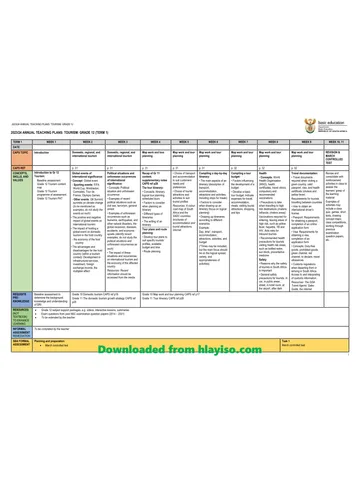
Gr 12 Tou ATP 2023 24
Question paper
Tourism Grade 12 Eastern Cape Mock 2025 Question Paper (Eng)
Question paper
Tourism Grade 12 NSC June 2025 Question Paper (English)
Question paper
Tourism Grade 12 NSC November 2025 Question Paper (Afr)
Question paper