
Downloaded from hlayiso.com
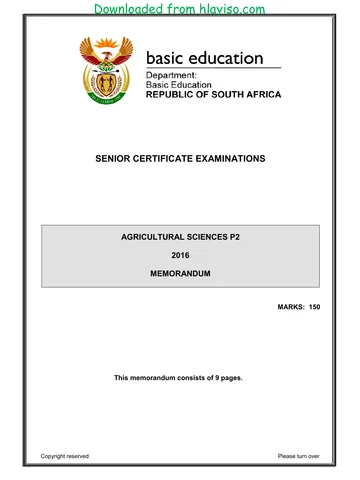
NATIONAL
SENIOR CERTIFICATE
GRADE 12
AGRICULTURAL SCIENCES P2
FEBRUARY/MARCH 2016
MEMORANDUM
MARKS: 150
This memorandum consists of 9 pages.
Copyright reserved Please turn over
Skip to contentAll 2016 papers 


View all
Agricultural Sciences Grade 12 P2 2016 Memo (Eng)
Grade 12 Agricultural Sciences Paper 2 memorandum from the NSC Supplementary Exam 2016 (English), 9 pages. Read online or download the free PDF.
Agricultural Sciences · Grade 12 · NSC Supplementary Exam · 2016. Memorandum, 9 pages. Read online or download the PDF.
- Subject
- Agricultural Sciences
- Grade
- Grade 12
- Document type
- Memorandum
- Year
- 2016
- Exam period
- NSC Supplementary Exam
- Paper
- 2
- Curriculum
- CAPS
- Pages
- 9
- File size
- 347.7 KB
Free to read online, no sign-up needed
Loading document…
Loading document…
1 of 9
This exam
NSC Supplementary Exam 2016
Questions in this paper
- Question 1.1Agricultural marketing20 marks
- Question 1.2Agricultural marketing10 marks
- Question 1.3Basic agricultural genetics10 marks
- Question 1.4Agricultural production factors5 marks
- Question 2.1Agricultural marketing10 marks
- Question 2.2Agricultural marketing6 marks
Show all 18 questions
- Question 2.3Agricultural marketing10 marks
- Question 2.4Agricultural entrepreneurship9 marks
- Question 3.1Agricultural production factors8 marks
- Question 3.2Agricultural production factors10 marks
- Question 3.3Agricultural production factors9 marks
- Question 3.4Agricultural production factors3 marks
- Question 3.5Agricultural production factors5 marks
- Question 4.1Basic agricultural genetics10 marks
- Question 4.2Basic agricultural genetics7 marks
- Question 4.3Basic agricultural genetics4 marks
- Question 4.4Basic agricultural genetics10 marks
- Question 4.5Basic agricultural genetics4 marks
Document textSearch extracted text and jump to a page.
Downloaded from hlayiso.com
Agricultural Sciences/P2 2 DBE/Feb.–Mar. 2016
NSC – Memorandum
SECTION A
QUESTION 1
1.1 1.1.1 B
1.1.2 C
1.1.3 A
1.1.4 C
1.1.5 B
1.1.6 C
1.1.7 A
1.1.8 D
1.1.9 D
1.1.10 C (10 x 2) (20)
1.2 1.2.1 D
1.2.2 C
1.2.3 E
1.2.4 A
1.2.5 G (5 x 2) (10)
1.3 1.3.1 Budget
1.3.2 Equilibrium price
1.3.3 Capital
1.3.4 Biometrics
1.3.5 Epistasis (5 x 2) (10)
1.4 1.4.1 Marketing
1.4.2 Technical
1.4.3 Net Farm Income
1.4.4 Skilled
1.4.5 Breeding value (5 x 1) (5)
TOTAL SECTION A: 45
Copyright reserved Please turn over
Downloaded from hlayiso.com
Agricultural Sciences/P2 3 DBE/Feb.–Mar. 2016
NSC – Memorandum
SECTION B
QUESTION 2: AGRICULTURAL MANAGEMENT AND MARKETING
2.1 The illustration representing marketing strategy
2.1.1 Marketing strategies
A A - Product
B B - Price
C C - Place
D D - Promotion (4)
2.1.2 TWO factors to consider when planning a product
• Quality
• Design
• Branding
• Packaging
• Size
• Warranty (Any 2) (2)
2.1.3 TWO ways to implement the strategy
• Advertising
• In-store promotion
• Direct mailing
• Trade fairs and exhibition
• Sponsorship
• Personal selling (Any 2) (2)
2.1.4 TWO aspects to consider when deciding on pricing
• Cost
• Demand
• Competition (Any 2) (2)
2.2 Marketing system
2.2.1 Identification of the marketing system
Co-operative marketing system (1)
2.2.2 THREE advantages of co-operative marketing
• Farmers (producers) will have a better chance to negotiate a
good price for their produce
• They will have an access to professional expertise
• They can afford better infrastructure as a group than as
individuals
• They can buy fertiliser or packaging material cheaper
• They can develop a brand for their produce which makes them
more visible to the potential buyers
• They can access funding from the government as a
cooperative (Any 3) (3)
Copyright reserved Please turn over
Downloaded from hlayiso.com
Agricultural Sciences/P2 4 DBE/Feb.–Mar. 2016
NSC – Memorandum
2.2.3 TWO principles of co-operative marketing
• Voluntary membership
• Democratic member control
• Member's economic participation
• Autonomy and independency (Any 2) (2)
2.3 Quantities of product 1 and 2 supplied
2.3.1 Formulation of hypothesis
Producers may not increase the supply of agricultural product
even when the price has increased in a short period of time
OR
If the price of an agricultural product increases, the supply may
not increase within a short period of time (2)
2.3.2 Calculation of price elasticity of supply for product 1 and 2
• Product 1 = 13%
20%
= 0,65 (2)
• Product 2 = 39%
20%
= 1,95 (2)
2.3.3 Interpretation of price elasticity of supply for the two products
• Supply for product 1 is inelastic
• Supply for product 2 is elastic (2)
2.3.4 TWO factors affecting supply of the products
• Price
• Possibilities of increasing the supply of goods/time
• Technology
• Production costs
• Expectations of the future price
• Environmental conditions
• Subsidies (Any 2) (2)
Copyright reserved Please turn over
Downloaded from hlayiso.com
Agricultural Sciences/P2 5 DBE/Feb.–Mar. 2016
NSC – Memorandum
2.4 SWOT analysis
2.4.1 Use of SWOT analysis to identify the following
(a) TWO strengths
• Availability of land
• Services by an extension officer
• Human resource (Any 2) (2)
(b) ONE weakness
• Lack of capital
• Lack of skills (Any 1) (1)
(c) ONE opportunity
• Identified market
• Services of the extension officer (Any 1) (1)
(d) TWO threats
• Unreliable weather
• Competition from another project/Flourishing project in a
nearby village
• Lack of funds
• Lack of skills (Any 2) (2)
2.4.2 THREE actions to correct threats
• Application of scientific methods/ use of modern technology
• Establishment of sound market chain
• Consider processing and value adding
• Source interest free funding and subsidies
• Consider training; internships and voluntary hands on
experience (Any 3) (3)
[35]
QUESTION 3: PRODUCTION FACTORS
3.1 Land as a production factor
3.1.1 TWO characteristics of land
• Land is subject to the law of diminishing return
• Land is durable (2)
3.1.2 Explanation of the law of diminishing return
• More units of fertiliser
• Did not result to proportional further increase the yield (2)
3.1.3 TWO functions of land from the case study
• It enables the production of food
• It provides physical space for industry (2)
Copyright reserved Please turn over
Downloaded from hlayiso.com
Agricultural Sciences/P2 6 DBE/Feb.–Mar. 2016
NSC – Memorandum
3.1.4 TWO ways to increase productivity of land
• Changing cropping systems/intercropping/adaptation to
scientific methods
• Restoring land potential/halting erosion
• Consolidate small uneconomic land units
• Improving water management/provision (Any 2) (2)
3.2 Capital as a production factor
3.2.1 Explanation of the assistance of using a cash flow budget
• It shows the flow of cash into and out of the farming
operation
• To determine the profit and loss (2)
3.2.2 Monthly income
• Sale of eggs = R8 000 per week x 4 = R32 000
• Sale of broilers = R12 500 per week x 4 = R50 000
= R32 000 + R50 000 = R82 000 (3)
3.2.3 Decision to continue with the business
Farmer must continue with the business (1)
3.2.4 Reason
• Income is more than the expenditure
• The business is run at a profit. (Profit is R43 000) (2)
3.2.5 TWO forms of capital
• Floating/working capital
• Movable capital (2)
3.3 Ability levels of farmers and farm workers
3.3.1 TWO skills of farm manager based on graph
• Planning
• Entrepreneurial (2)
3.3.2 One important skill needed by the farm worker
Technical skill (1)
3.3.3 Justification of skill needed by the farm worker
• Worker needs to perform practical activities
• using hands (2)
3.3.4 TWO management skills important to the farmer other than the
skills in the graph
• Financial
• Communication and interpersonal
• Problem-solving
• Decision-making (Any 2) (2)
Copyright reserved Please turn over
Downloaded from hlayiso.com
Agricultural Sciences/P2 7 DBE/Feb.–Mar. 2016
NSC – Memorandum
3.3.5 TWO management principles
• Planning
• Motivation
• Control
• Implementation
• Control (Any 2) (2)
3.4 Labour Legislation
3.4.1 21 days leave of absence farm employees entitled to
Annual leave (1)
3.4.2 4 months leave of absence female employees entitled to
Maternity leave (1)
3.4.3 Leave of absence for flu
Sick leave (1)
3.5 Labour
3.5.1 Calculation of worker payment during public holiday
• R111.72 x 2 = R223.44 OR R111.72 x 2 x 3 =
R670.32
• R223.44 x 3 = R670.32 (2)
3.5.2 Deduction of a labour practice
Unfair labour practice (1)
3.5.3 Justification of answer in QUESTION 3.5.2
• Worker underpaid/worker received R270.32 less
• Public holidays are double paid according to Public Holiday
Act/ allowance on public holidays is double the allowance of
normal working days (2)
[35]
QUESTION 4: BASIC AGRICULTURAL GENETICS
4.1 Growth rates between cattle breeds
4.1.1 Type of breeding system
Cross breeding (1)
4.1.2 Parents that produced calves with highest average daily gain
Hereford bulls and Brahman cows (1)
4.1.3 TWO reasons for better performance of these calves
• Offspring have hybrid vigour/heterosis
• Are better adapted to poor veld conditions/more hardy
• Have a better feed conversion rate (Any 2) (2)
Copyright reserved Please turn over
Downloaded from hlayiso.com
Agricultural Sciences/P2 8 DBE/Feb.–Mar. 2016
NSC – Memorandum
4.1.4
Poor
Performence of differnet crossings on different
pasture conditions Average
1000 Good
900
Average daily gain (g/day)
800
700
600
500
400
300
200
100
0
Number 1 Number 2 Number 9
Number of crossing
Criteria/rubric/marking guidelines
• Correct heading
• X axis - correctly calibrated and labelled (number crossing)
• Y axis - correctly calibrated and labelled (ADG)
• Correct units (g/day)
• Accuracy
• Bar graph (6)
4.2 Inheritance
4.2.1 Type of inheritance controlling milk yield
Polygenic inheritance (1)
4.2.2 Milk yield of a Jersey cow with genotype AAbb
AA = 20+ 20 = 40 litres
AAbb = 200 + 40 litres
= 240 litres (3)
4.2.3 Phenotypic and genotypic ratio of F1-generation
AABB x aabb
AB x ab
Genotype : 4 AaBb
Phenotype : all producing 240 litres (3)
4.3 Inheritance
4.3.1 The phenomenon in QUESTION 4.3
Atavism (1)
Copyright reserved Please turn over
Downloaded from hlayiso.com
Agricultural Sciences/P2 9 DBE/Feb.–Mar. 2016
NSC – Memorandum
4.3.2 Reason
• A recessive gene for red which was switched off and not
expressed
• In the phenotype in the past is now switched on and
expressed (2)
4.3.3 Alternative term for atavism
Throwback (1)
4.4 Selection and breeding
4.4.1 Differentiation between selection and heritability
Selection
• is choosing of individuals for breeding purposes
• due to superior characteristics (2)
Heritability
• is the degree to which the characteristics are
• determined by genetic factors (2)
4.4.2 TWO advantages of a species crossing
• They are hardy animals
• They are drought animals
• They are highly durable (Any 2) (2)
4.4.3 TWO related breeding systems
• Line breeding
• Inbreeding (2)
4.4.4 Importance of using EBV
It indicates the heritability of a particular characteristic
to predict the success of a breeding programme (2)
4.5 Effects of mutagenic agents
4.5.1 Gamma and X-rays
Damages DNA molecule and causes it to break (1)
4.5.2 Metals
Change the chemical structure of a DNA molecule (1)
4.5.3 Alkaloids
They prevent chromosome segregation (1)
4.5.4 Viruses
They insert their own DNA (1)
[35]
TOTAL SECTION B: 105
GRAND TOTAL: 150
Copyright reserved
Study this subject
Recommended for this subject
Memorandum
Agricultural Sciences Grade 12 P2 2016 Memo (Afr)
Memorandum
Agricultural Sciences Grade 12 P1 2016 Memo (Afr)
Memorandum
Agricultural Sciences Grade 12 P2 2016 Memo (Eng)
Memorandum
Agricultural Sciences Grade 12 P2 2016 Memo (Afr)
Memorandum
Agricultural Sciences Grade 12 P2 NSC June 2016 Memo (Eng)
Memorandum
Agricultural Sciences Grade 12 P2 NSC November 2016 Memo
More from Grade 12 Agricultural Sciences
Annual teaching plan
Gr 12 Agric Sci ATP 2023 24
Question paper
Agricultural Sciences Grade 12 P1 NSC June 2025 QP (Eng)
Question paper
Agricultural Sciences Grade 12 Eastern Cape June 2024 QP
Question paper
Agricultural Sciences Grade 12 P1 2024 QP (Afr)
Question paper
Agricultural Sciences Grade 12 P1 2024 QP (Sesotho)
Question paper