
Downloaded from hlayiso.com
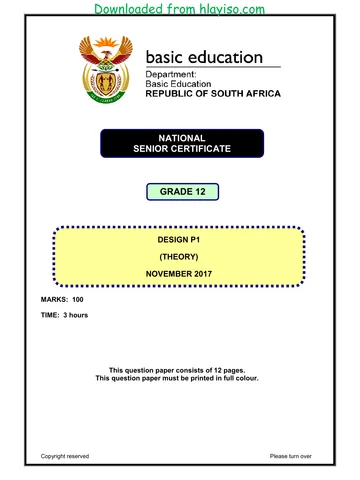
NATIONAL
SENIOR CERTIFICATE
GRADE 12
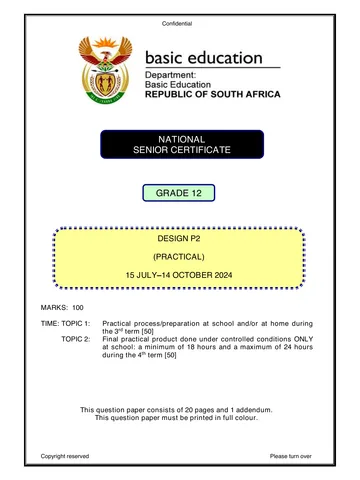
DESIGN P2
(PRACTICAL)
24 JULY–20 OCTOBER 2017
MARKS: 100
TIME: TOPIC 1: Practical process/preparation at school and/or at home during
the 3rd term [50]
TOPIC 2: Final practical product done under controlled conditions ONLY
at school: a minimum of 12 hours and a maximum of 24 hours
during the 4th term [50]
This question paper consists of 23 pages and 1 addendum.
This question paper must be printed in full colour.
Copyright reserved Please turn over
Skip to contentAll 2017 papers 
View all
Design Grade 12 P2 NSC November 2017 Question Paper (Eng)
Grade 12 Design Paper 2 question paper from the NSC November Exam 2017 (English), 24 pages. Read online or download the free PDF.
Design · Grade 12 · NSC November Exam · 2017. Question paper, 24 pages. Read online or download the PDF.
- Subject
- Design
- Grade
- Grade 12
- Document type
- Question paper
- Year
- 2017
- Exam period
- NSC November Exam
- Paper
- 2
- Curriculum
- CAPS
- Pages
- 24
- File size
- 4.8 MB
Free to read online, no sign-up needed
Loading document…
Loading document…
1 of 24
This exam
NSC November Exam 2017
Document textSearch extracted text and jump to a page.
Downloaded from hlayiso.com
Design/P2 2 DBE/November 2017
NSC
INSTRUCTIONS AND INFORMATION
1. This question paper consists of TWO sections:
TOPIC 1: The examination sourcebook/workbook (50 marks)
TOPIC 2: The final practical examination product (50 marks)
TOTAL: 100 marks
2. The question paper has TWO themes. Choose ONE or COMBINE THE
TWO OPTIONS.
Copyright reserved Please turn over
Downloaded from hlayiso.com
Design/P2 3 DBE/November 2017
NSC
BRIEF/THEME 1: COMMEMORATIVE DESIGN
EROS
CULTURE
Diverse
Copyright reserved Please turn over
Downloaded from hlayiso.com
Design/P2 4 DBE/November 2017
NSC
COMMEMORATIVE DESIGN
• Pays homage • Shows respect • Symbolises
• Celebrates • Honours • Acknowledges
• Salutes • Toasts • Pays tribute to
Copyright reserved Please turn over
Downloaded from hlayiso.com
Design/P2 5 DBE/November 2017
NSC
In South Africa, many people, cultures, historical events and occasions have been
commemorated through the use of various design forms, for example:
• Nelson Mandela – posters, T-shirts, mugs, inauguration coins, stamps
• The Sharpeville Massacre – Sharpeville Memorial
• Apartheid – displays in the Apartheid Museum
• The origins of the Afrikaans language – the Afrikaans Language Monument
• Hector Peterson – the Hector Peterson Memorial
• The birth of the Lesotho Prince – a Basotho blanket
• The ancient Mapungubwe civilisation – a Mapungubwe typeface
• The first protest against apartheid pass laws – the Red Location Museum
• The Voortrekkers – the Voortrekker Monument, plates, teaspoons, stamps
• Shaka Zulu's impis (warriors) – Nguni furniture designs, plates
• Equality for all – Constitution Hill
• Hansie Cronjé – wine labels, memorabilia, comic strips
• The arrival of the French Huguenots – the Huguenot Monument
The production of memorabilia, creation of public art/sculptures, the building of
museums, designing of cartoons, graffiti, typeface and the making of films all contribute
to the commemoration of our legacy. Commemorative design plays a pivotal role in
shaping our collective identity and heritage.
Commemorative designs are preserved in numerous museums in an effort to protect
and guard our unique national cultural history, our political successes and defeats, and
our rich crafts, art and languages. All of these commemorative designs unify our
nation.
At the University of Cape Town students highlighted the need to identify with
post-apartheid heroes and heroines. They believed that the Cecil John Rhodes statue
needed to be removed to make way for new role models. The realisation of a new
South African cultural identity remains a challenge in creating a shared new identity.
This new cultural identity has now resulted in more commemorative designs that
celebrate heroes and heroines who were not previously celebrated. These
commemorative designs are now used as marketing tools to attract tourists to
South Africa.
Create an original design solution to commemorate an actual historical event or
heroes and heroines that have been (or have not been) commemorated already,
for example sporting icons, Marikana, Heritage Day, cultural events.
Create the design in ONE of the following design categories that interprets the theme
in an original and creative manner:
• Visual Communication/Information Design and/or Digital Design
• Surface Design and Two-dimensional Craft Design
• Product Design and Three-dimensional Craft Design
• Environmental Design
Do NOT copy the examples provided.
Copyright reserved Please turn over
Downloaded from hlayiso.com
Design/P2 6 DBE/November 2017
NSC
VISUAL COMMUNICATION/INFORMATION DESIGN AND DIGITAL DESIGN
Copyright reserved Please turn over
Downloaded from hlayiso.com
Design/P2 7 DBE/November 2017
NSC
SURFACE DESIGN AND TWO-DIMENSIONAL CRAFT DESIGN
Copyright reserved Please turn over
Downloaded from hlayiso.com
Design/P2 8 DBE/November 2017
NSC
PRODUCT DESIGN AND THREE-DIMENSIONAL CRAFT DESIGN
Copyright reserved Please turn over
Downloaded from hlayiso.com
Design/P2 9 DBE/November 2017
NSC
ENVIRONMENTAL DESIGN
Copyright reserved Please turn over
Downloaded from hlayiso.com
Design/P2 10 DBE/November 2017
NSC
BRIEF/THEME: 2: OPTICAL MOTION
Optical Motion
Copyright reserved Please turn over
Downloaded from hlayiso.com
Design/P2 11 DBE/November 2017
NSC
For many centuries designers and artists have been intrigued by the nature of
perception or seeing and the behaviour of the eye. Since the Renaissance Period,
artists, sculptors and architects have used advanced perspective techniques to create
the illusion of three dimensions on a two-dimensional surface.
The 1950s saw the introduction of optical illusion in art when a number of artists
developed illusionary methods that confused perception. They focused on the
investigation into the science of optics, which was supported by an increase in
technology and psychology. Optical Art and Kinetic Art have a great impact on
design.
Optical design is mostly mathematical, leans towards Abstract Art and is considered
a branch of Pop Art. The use of repetitive geometric forms in black and white or in
contrasting colours creates vibrating effects.
Optical design excites the eye and brings a static image to life, pushing the boundaries
of our perception. In order to create artistic motion different methods were used to
trick and confuse the public eye, playing with our perceptions.
Motion can also be created in design with the use of elements, such as diagonal and
curvilinear lines, repetition of colour and form, jagged shapes and lines, as well as with
fragmented, deconstructed images, shapes and forms.
Thomas Heatherwick
Frank Gehry
Copyright reserved Please turn over
Downloaded from hlayiso.com
Design/P2 12 DBE/November 2017
NSC
No painter, dead or alive, has ever made us more aware of our eyes
than Bridget Riley. – Robert Melville 1971
The beginnings of illusion and motion art are seen in the simplicity of
black and white contrast. – Bridget Riley
Victor Vasareli also created designs that experimented with illusions and motion, BUT
he included shapes that were bright monochromatic and polychromatic in colour.
Copyright reserved Please turn over
Downloaded from hlayiso.com
Design/P2 13 DBE/November 2017
NSC
Riley and Vasareli used tessellations (mathematical structured patterns that use grids
to create optical illusions and motion) to create complex, mathematically structured
compositions. Their starting point was a grid similar to the tessellations developed by
MC Escher, as seen in the structures below. To be able to create complicated optical
illusions, it is important for you to use tessellation grid formations as the starting point.
Today, in a Postmodern context, designers, such as Karl Lagerfeld, Louis Vuitton,
Giorgio Armani and Issey Miyake, are elevating Riley's graphic stripe to become the
focal point of their designs.
Copyright reserved Please turn over
Downloaded from hlayiso.com
Design/P2 14 DBE/November 2017
NSC
Karl Lagerfeld elevates Riley's monochromatic stripes with bold black and white lines
with a slight curve at the bottom. His other designs use a checkerboard design related
to tessellations.
Louis Vuitton uses repetitive overlapping lines to create a vibrant neon light logo.
One of Vuitton's retail stores is creatively clad with a checkerboard vertical garden
design reminiscent of previous tessellation designs.
Copyright reserved Please turn over
Downloaded from hlayiso.com
Design/P2 15 DBE/November 2017
NSC
In Giorgio Armani's shoe and handbag display window we see bold use of lines that
create dynamic motion and depth. The designs clearly use Escher's grids and
tessellations.
Issey Miyake's optic designs are so convincing that the clothes express the dizzy
dynamism of a kinetic sculpture. The fragmented square and triangular patterns on the
handbags create a flickering motion.
Create an original design solution based on the theme of 'Optical Motion' that will
be exhibited at the Design Indaba Expo 2018.
Use ONE of the following design categories to create your design solution:
• Visual Communication/Information Design and/or Digital Design
• Surface Design and Two-dimensional Craft Design
• Product Design and Three-dimensional Craft Design
• Environmental Design
Do NOT copy the examples provided.
Copyright reserved Please turn over
Downloaded from hlayiso.com
Design/P2 16 DBE/November 2017
NSC
VISUAL COMMUNICATION/INFORMATION DESIGN AND/OR DIGITAL DESIGN
Copyright reserved Please turn over
Downloaded from hlayiso.com
Design/P2 17 DBE/November 2017
NSC
SURFACE DESIGN AND TWO-DIMENSIONAL CRAFT DESIGN
Copyright reserved Please turn over
Downloaded from hlayiso.com
Design/P2 18 DBE/November 2017
NSC
PRODUCT DESIGN AND THREE-DIMENSIONAL CRAFT DESIGN
Copyright reserved Please turn over
Downloaded from hlayiso.com
Design/P2 19 DBE/November 2017
NSC
ENVIRONMENTAL DESIGN
Copyright reserved Please turn over
Downloaded from hlayiso.com
Design/P2 20 DBE/November 2017
NSC
REQUIREMENTS
SECTION A
TOPIC 1: THE DESIGN PROCESS [50]
1. All processIpreparatory work for your design must be shown in a
sourcebook/workbook.
2. This will involve the processes from conceptualisation to realisation.
3. Thorough investigation of problems posed by the design brief should be
shown.
4. The sourcebook/workbook must be presented in the form of an album (that is
in book form).
5. It must open easily and have pages that turn easily.
6. The sourcebook/workbook must be made of light material to facilitate
transport where work is moderated at a central venue.
7. Ensure that the sourcebook/workbook is presented professionally.
NOTE:
• As TOPIC 1 (process/preparation) has the same mark allocation as TOPIC 2 (the
final product), it should be given enough time to acknowledge its importance.
• Your teacher may be involved in this preliminary preparatory session (TOPIC 1
only).
• You may work at home.
CRITERIA FOR THE DESIGN PROCESS (TOPIC 1)
You should present the following (refer to the NSC Design Examination Guidelines):
• Expression of intention and rationale (10)
• Evidence of research, experimentation and reflection (10)
• Evidence of detailed planning and presentation related to the final concept (30)
[50]
Copyright reserved Please turn over
Downloaded from hlayiso.com
Design/P2 21 DBE/November 2017
NSC
SECTION B
TOPIC 2: THE FINAL PRODUCT [50]
Although it is recommended that a two-dimensional design should NOT be larger than
A2 in size, candidates' work is not restricted regarding size.
The size of a three-dimensional design will depend on the function of the object being
made. Take into account that the final product might have to be transported to a central
marking venue, and you should therefore be mindful of possible problems during
transportation.
NOTE:
• Your teacher may NOT assist you in any way during the final production of the
design.
• ALL work must be done under the teacher's and/or appointed invigilator's
supervision at your school.
• Any form of direct copying/plagiarism or of work that is not your original work will
be strictly penalised.
• A declaration of authenticity (ADDENDUM A) must be completed by yourself and
the chief invigilator/teacher.
• Work must be done on a continuous basis, for example during three consecutive
days under controlled circumstances.
CRITERIA FOR THE DESIGN PRODUCT (TOPIC 2)
You should use the following criteria (refer to the NSC Design Examination
Guidelines):
• Creativity/Originality/Interpretation in terms of the concept and solutions that are
relevant to the brief (10)
• Evidence of design involvement: the appropriate use of design elements and
principles (10)
• Technique/Craftsmanship/Method (10)
• The design solution with evidence of at least 12 hours' but no more than
24 hours' work under controlled circumstances (10)
• Professional presentation and functionality of the design solution (10)
[50]
TOTAL: TOPIC 1 (50) + TOPIC 2 (50) 100
Copyright reserved Please turn over
Downloaded from hlayiso.com
Design/P2 22 DBE/November 2017
NSC
INSTRUCTIONS TO THE TEACHER
PRACTICAL EXAMINATION TOPIC 1 (50 MARKS) AND TOPIC 2 (50 MARKS) –
TASK 7
1. This practical examination consists of ONE question paper. This question paper
comprises TWO parts, TOPIC 1 (the examination sourcebookIworkbook and
TOPIC 2 (the final practical examination product).
2. This practical question paper should be given to the candidates on Monday
24 July 2017. The final submission date will be Friday 20 October 2017.
3. TOPIC 1 (design process) has the same weighting as TOPIC 2 (the final
product) and it should therefore be given enough time to acknowledge its
importance.
4. Consequently, candidates should have enough time to do their TOPIC 1
(preparation/design process). The teacher may only be involved in this
preliminary preparatory session and NOT in TOPIC 2. Due to the preparatory
nature of TOPIC 1, candidates are allowed to work at home.
5. Candidates must use the TOPIC 1 sourcebookIworkbook as a point of reference
during their TOPIC 2 examination. Both TOPIC 1 and TOPIC 2 examination
work must be submitted to the teacher/invigilator immediately after the TOPIC 2
examination has been completed.
6. The teacher may NOT assist the candidate in any way during the final
production of the design product (TOPIC 2).
7. Any form of direct copying/plagiarism or work that is not the candidate's
original work will be strictly penalised.
8. TOPIC 2 must be done on a continuous basis during contact time, for example
during three consecutive days under controlled circumstances.
9. TOPIC 2 must be done at the candidate's examination centre, under the
supervision of the teacher/invigilator. TOPIC 2 work must NOT be done at home.
10. TOPIC 2 work must NOT be removed from the examination centre under any
circumstances.
11. Each province will determine the marking process of TOPIC 1 (sourcebookI
workbook) and TOPIC 2 (final product). Schools will be notified by the provinces
regarding the date, time and venue for the submission of work to the
examination centres, where applicable.
12. The examination TOPIC 1 should be professionally presented in a
sourcebookIworkbook in album format.
13. The sourcebook/workbook and final product must be labelled neatly and clearly.
14. ADDENDUM A must be completed in full and the school stamp should appear in
the appropriate space. Attach ADDENDUM A securely to the final examination
work (sourcebook/workbook and/or final product).
Copyright reserved Please turn over
Downloaded from hlayiso.com
Design/P2 23 DBE/November 2017
NSC
ASSESSMENT GUIDELINES
OUTCOMES REQUIREMENTS WEIGHTING MARKS
%
SOURCEBOOK/WORKBOOK
TOPIC 1 Expression of intention and 10
The Design Process rationale
The candidate is able to
understand the design process
Evidence of research, 10
from conceptualisation to
realisation.
experimentation and reflection 50
Evidence of detailed planning and 30
presentation related to the final
concept
TOPIC 2 Creativity/Originality/Interpretation 10
Design Production in terms of the concept and
solutions that are relevant to
The candidate is able to produce the brief
and present a body of work in the
chosen discipline(s) which shows
an understanding of design skills
and production processes. Evidence of design involvement: 10
THE FINAL PRODUCT
the appropriate use of design
elements and principles
50
Technique/Craftsmanship/Method 10
The design solution with evidence 10
of at least 12 hours' but no more
than 24 hours' work under
controlled circumstances
Professional presentation and 10
functionality of the design solution
TOTAL 100
NOTE: Teachers and markers must refer to the NSC Design Examination Guidelines
and the PAT Guidelines for detailed assessment criteria.
Copyright reserved
Downloaded from hlayiso.com
Design/P2 DBE/November 2017
NSC
ADDENDUM A
This addendum must be detached, copied, completed, signed and attached to the
final examination work (workbook/sourcebook and/or final product).
NOVEMBER 2017 SOURCEBOOK/WORKBOOK
1. Name of subject DESIGN
2. Code of subject DSGN
DECLARATION OF AUTHENTICITY
This work was done under supervision and without any help. This is to certify that all work
submitted is the original and own work of the candidate.
Centre number
Examination number
District/Circuit
Signatures and date School stamp
Candidate
Principal
Chief Invigilator/Teacher
NOVEMBER 2017 FINAL PRODUCT
1. Name of subject DESIGN
2. Code of subject DSGN
DECLARATION OF AUTHENTICITY
This work was done under supervision and without any help. This is to certify that all work
submitted is the original and own work of the candidate.
Centre number
Examination number
District/Circuit
Signatures and date School stamp
Candidate
Principal
Chief Invigilator/Teacher
Copyright reserved
Study this subject
Recommended for this subject
Question paper
Design Grade 12 P2 NSC November 2017 Question Paper (Afr)
Question paper
Design Grade 12 P1 NSC November 2017 Question Paper (Afr)
Question paper
Design Grade 12 P1 NSC November 2017 Question Paper (Eng)
Question paper
Design Grade 12 P2 NSC November 2023 Question Paper (Afr)
Question paper
Design Grade 12 P2 NSC November 2023 Question Paper (Eng)
Question paper
Design Grade 12 P2 NSC November 2021 Question Paper (Afr)
More from Grade 12 Design
Annual teaching plan
Gr 12 Des ATP 2023 24
Memorandum
Design Grade 12 Paper 1 NSC June 2025 Memo (Afrikaans)
Memorandum
Design Grade 12 Paper 1 NSC November 2025 Memo (English)
Memorandum
Design Grade 12 Paper 1 NSC November 2025 Memo (Afrikaans)
Memorandum
Design Grade 12 Paper 1 NSC November 2025 Memo (Afrikaans)
Question paper