
Downloaded from hlayiso.com
NATIONAL
SENIOR SERTIFICATE
GRADE 11
NOVEMBER 2016
HISTORY P2
ADDENDUM
This addendum consists of 10 pages.
Skip to contentAll 2016 papers 
View all
History Grade 11 P2 Eastern Cape November 2016 Addendum
Grade 11 History Paper 2 addendum from the Eastern Cape November 2016 (English), 10 pages. Read online or get the free PDF download.
History · Grade 11 · Eastern Cape November · 2016 · English. Addendum, 10 pages. Read online or download the PDF.
- Subject
- History
- Grade
- Grade 11
- Language
- English
- Document type
- Addendum
- Year
- 2016
- Exam period
- Eastern Cape November
- Paper
- 2
- Curriculum
- CAPS
- Pages
- 10
- File size
- 1.2 MB
Free to read online, no sign-up needed
Loading document…
Loading document…
1 of 10
This exam
Questions in this paper
Document textSearch extracted text and jump to a page.
Downloaded from hlayiso.com
2 HISTORY P2 (ADDENDUM) (EC/NOVEMBER 2016)
SECTION A: SOURCE-BASED QUESTIONS
QUESTION 1: WHAT FACTORS CONTRIBUTED TO THE GROWTH OF
AFRICAN NATIONALISM IN SOUTH AFRICA?
SOURCE 1A
This extract focuses on the general approaches to Pan-Africanism which can be
traced far back into the 15th century and beyond.
Pan-Africanism is a general term for various movements in Africa that have as their
common goal the unity of Africans and the elimination of colonialism and white
supremacy (upper-hand) from the continent.
There are two general approaches to Pan-Africanism, namely, the Afrocentric and
Eurocentric. The Afrocentric approach posits that the historical struggle of Africans
against external aggression, exploitation, occupation and domination did not begin
with European contact or the incursion (sudden arrival) into Africa in the fifteenth
century, but in the B.C. era.
Conversely, the Eurocentric explanation regards Pan-Africanism as an idea
conceived (imagined)in response to European slavery and colonialism. Pan-
Africanism is generally regarded as a 20th-century movement, even if it can be
traced back far into the 15th-century and beyond.
[Taken from Gaines Junction: Undergraduate Interdisciplinary Journal of History Giselle D. Aris,
‘Pan-Africanism: Competing Interpretations’, (Vol. 3, No.1)]
SOURCE 1B
A table showing the growth in the number of industrial workers between the years
1938–1939.
1938–1939 1944–1945
White males 116 193 130 415
White females 28 645 35 104
Black males 196 178 299 334
Black females 11 484 23 808
[Source: Making History Grade 12, Friedman, Mashini and Johannesson, 1998, p54]
Copyright reserved Please turn over
Downloaded from hlayiso.com
(EC/NOVEMBER 2016) HISTORY P2 (ADDENDUM) 3
SOURCE 1C
The picture shows long queues of people walking to work during the bus boycott
of 1944 in Alexandria.
[Source: Published in The Star, 1944]
Copyright reserved Please turn over
Downloaded from hlayiso.com
4 HISTORY P2 (ADDENDUM) (EC/NOVEMBER 2016)
QUESTION 2: WHAT WERE THE PERSPECTIVES OF MIDDLE EAST
LEADERS ON THE REFUGEE PROBLEM IN THE MIDDLE
EAST?
SOURCE 2A
The late Egyptian President Anwar Sadat stated in his historic address to the
Israeli Knesset on 20 November 1977:
“We will not accept any talk about lasting and durable peace ... while you are
occupying Arab land with military force. ... As for the Palestinian question, nobody
denies that it’s the essence of the problem as a whole ...
There is no use not recognising the Palestinian people and their own right in
establishing their homeland, and their right of return.”
[Adapted from Stephen P Halbrook, The Journal of Liberation Studies, The Alienation of a
Homeland: How Palestine Became Israel, Vol. V, No. 4 (Fall 1981), p357]
SOURCE 2B
These are remarks by Yitshak Rabin (Prime Minister) on the occasion of the
signing of the Israeli-Palestinian Declaration of Principles.
Washington, September 13, 1993
Mr President, ladies and gentlemen,
Let me say to you, the Palestinians: We are destined to live together on the same
soil, in the same land. We, the soldiers who have returned from battle stained with
blood, we who have seen our relatives and friends killed before our eyes, we who
have attended their funerals and cannot look into the eyes of their parents, we
who have come from a land where parents bury their children, we who have
fought against you, the Palestinians:
We say to you today in a loud and clear voice: Enough of blood and tears.
Enough. We have no desire for revenge. We harbour no hatred towards you. We,
like you, are people who want to build a home, to plant a tree, to love, to live side
by side with you in dignity, in empathy (understand someone else’s feelings), as
human beings, as free men. We are today giving peace a chance, and saying
again to you: Enough. Let us pray that a day will come when we all will say:
Farewell to the arms.
[Taken from http://www.ijs.org.au. Accessed on 6 June 2016.]
Copyright reserved Please turn over
Downloaded from hlayiso.com
(EC/NOVEMBER 2016) HISTORY P2 (ADDENDUM) 5
SOURCE 2C
This excerpt addresses the refugee problem of both Palestinians and Jews as
stated by Israeli Prime Minister Benjamin Netanyahu in 2011.
The refugee problems [i.e. Jewish and Palestinian refugees] are settled in these
two respective states – the question of Palestinian refugees will be resolved in
the Palestinian state and not in Israel. Just as the question of Jewish refugees
caused by that same Arab assault on Israel in 1948, was resolved within the
Jewish state. The Arab attack, the attack of five Arab armies, with the
Palestinians, on the embryonic (motherly) Jewish state caused two refugee
problems. About 650,000 Palestinian refugees and a somewhat larger number of
Jewish refugees were expelled from Arab states. Tiny Israel absorbed all the
Jewish refugees and the vast Arab world refused to absorb the Palestinian
refugees, and neither justice nor common sense mandates (official power to do
something) that 63 years later, the Arab world or the Palestinians will come to us
and say: Now, absorb the great-great-grandchildren of this part of the refugee
problem that we created ourselves. The solution to the refugee problem, both in
a practical sense and in the question of justice has to be addressed in the
Palestinian state and not at the expense of the solitary, the one and only Jewish
State.
[Source: June 28, 2011 – Benjamin Netanyahu, MS . Accessed on 6 June 2016.]
Copyright reserved Please turn over
Downloaded from hlayiso.com
6 HISTORY P2 (ADDENDUM) (EC/NOVEMBER 2016)
SOURCE 2D
This picture and extract depict the issue of Palestinian refugees after the First Arab-
Israeli War.
VISUAL SOURCE
Three-quarters of a million Palestinians fled their homes during the war.
WRITTEN SOURCE
OPINION 1:
SACHAR (pro-Palestinian reporter): No Arab government was ordering these people to
flee. On the contrary, they were ordering them to stay put, under no circumstances to
give over their territory to the Jews. It is a myth to assume that these people left
voluntarily.
OPINION 2:
MORRIS (anti-Palestinian reporter): For good military reasons Israelis wanted clear
lines of communication behind the lines. They didn’t want snipers. They didn’t want
guerrillas (members of unofficial military groups) operating behind the lines. So they
wanted to get rid of Arab communities. So there were expulsions (ordered to leave the
country officially) in various areas.
[Taken from The Cold War, D. Heate]
Copyright reserved Please turn over
Downloaded from hlayiso.com
(EC/NOVEMBER 2016) HISTORY P2 (ADDENDUM) 7
QUESTION 3: WHAT WERE THE CAUSES AND IMPACT OFTHE BANTU
EDUCATION ACT OF 1953 ON BLACK STUDENTS?
SOURCE 3A
An extract about Bantu Education reflecting the role played by the Department of
Native Affairs.
African schooling was still neither free nor compulsory, as it was for whites.
Certainly, educational provision for Africans before this period had been unequal
and most government schools separated white and African pupils. However, the
Bantu Education Act brought all African schools under the control of the
Department of Native Affairs, thus phasing out the independent missionary
institutions which had previously led the field in African education. It also imposed
a uniform curriculum which stressed separate ‘Bantu culture’ and deliberately
prepared students for little more than manual labour.
[Taken from Key History for GCSE: Teacher’s Guide]
SOURCE 3B
This table reflects the amount of money in Rands spent on the education of each
African, Coloured, Indian and White child between 1953/54 and 1975/76.
SEPARATE AND UNEQUAL EDUCATION ENFORCED
Year African Coloured Indian White
1953/54 17 40 40 128
1969/70 17 73 81 282
1975/76 42 140 190 591
[Adapted from The Right to Learn by P. Christie]
Copyright reserved Please turn over
Downloaded from hlayiso.com
8 HISTORY P2 (ADDENDUM) (EC/NOVEMBER 2016)
SOURCE 3C
This source indicates how Black learners experienced serious educational
problems during teaching and learning in the 1950s.
Expenditure on Bantu Education increased in the late 1960s, once the apartheid
government saw the need for a trained African labour force. Through this, more
African children attended school than under the old missionary system of
education, albeit grossly deprived of facilities in comparison with education of other
races, especially whites.
Nationally, pupil-teacher ratios in African schools went from 46 : 1 in 1955 to
58 : 1 in 1967. The classrooms were overcrowded and used on a rotational-basis.
There was also a lack of teachers, and many of those who did teach were under-
qualified. In 1961, only 10 per cent of Black teachers held a matric certificate.
Black education was essentially deteriorating, with teachers being less qualified
than their students.
[Source: http://sahistory.org.za. Accessed on 6 June 2016.]
Copyright reserved Please turn over
Downloaded from hlayiso.com
(EC/NOVEMBER 2016) HISTORY P2 (ADDENDUM) 9
SOURCE 3D
This source shows school children with their parents protesting against the Bantu
Education Act in 1954.
.
About 7 000 children were expelled from school because of their protests. The ANC
called for a boycott of schools to begin on 1 April 1954. In most places the boycotts
lasted only a few weeks as parents did not want their young children to miss out on
any education at all. As one African mother said about Bantu Education, “Half a loaf
of bread is better than nothing at all.”
[Taken from Viva History, 2012, p314]
ITS TIME TO WAKE UP WE REALLY WANT HELP!
AFRICANS
CHILDREN MUST NOT
DRINK POISON
Copyright reserved Please turn over
Downloaded from hlayiso.com
10 HISTORY P2 (ADDENDUM) (EC/NOVEMBER 2016)
ACKNOWLEDGEMENTS
Visual sources and other historical evidence were taken from the following:
Angier KL, et al 2012, Viva History, p314 (Vivlia Publishers)
Cloete, B. et al. 2012, Spot On (Heinemann)
Frank. F. 2012. New Generations (New Generations Publishers)
Gaines Junction: Undergraduate Interdisciplinary Journal of History Giselle
D.Aris, ‘Pan-Africanism: Competing Interpretations’, (Vol. 3, No.1).
Graves et al 2006, Moments in History Grade 11, p136 (Juta Publishers)
Heate, D, The Cold War (Heinemann)
http://www.ijs.org.au. Accessed on 6 June 2016.
http://sahistory.org.za. Accessed on 6 June 2016.
Internet source: anc.org.za – Accessed on 6 June 2016.
June 28, 2011 – Benjamin Netanyahu, MS Accessed on 6 June 2016.
Key History for GCSE: Teacher’s Guide
Kristie, P. (1991) The Right to Learn: The Struggle for Education in South
Africa. Johannesburg: SACHED/Ravan. Revised and Expanded Edition
(reprinted 1992, 1994, 2006). – See more at:
http://www.education.uct.ac.za/edu/staff/academic/pchristie#sthash.fIX3Cfsl.dpuf
Stephen P Halbrook, The Journal of Liberation Studies, The Alienation of a
Homeland: How Palestine Became Israel, Vol. V, No. 4 (Fall 1981), p357
The Mariners’ Museum/CORBIS Great Stock
www.newint.org.27June 2005. Accessed on 6 June 2016.
Copyright reserved Please turn over
Study this subject
Recommended for this subject
Memorandum
History Grade 11 P2 Eastern Cape November 2016 Memo (Eng)
Addendum
History Grade 11 P2 Eastern Cape November 2020 Addendum
Question paper
History Grade 11 P2 Eastern Cape November 2022 QP (Eng)
Memorandum
History Grade 11 P2 Eastern Cape November 2020 Memo (Eng)
Memorandum
History Grade 11 P2 Eastern Cape November 2019 Memo (Eng)
Question paper
History Grade 11 P2 Eastern Cape November 2018 QP (Eng)
More from Grade 11 History
Memorandum
History Grade 11 Paper 1 November Mock 2026 Memo (English)
Annual teaching plan
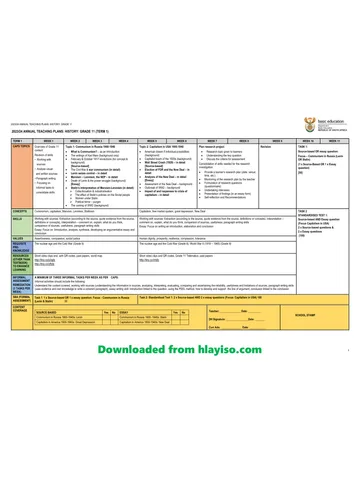
Gr 11 His ATP 2023 24
Question paper
History Grade 11 P1 Eastern Cape June 2025 Question Paper
Question paper and memo
History Grade 11 Paper 2 Eastern Cape June 2025 Paper & Memo
Memorandum
History Grade 11 Paper 1 Eastern Cape November 2025 Memo
Memorandum