
Downloaded from hlayiso.com
NATIONAL
SENIOR CERTIFICATE
GRADE 11
NOVEMBER 2019
HISTORY P2
MARKING GUIDELINE
MARKS: 150
This marking guideline consists of 19 pages.
Skip to contentAll 2019 papers 
View all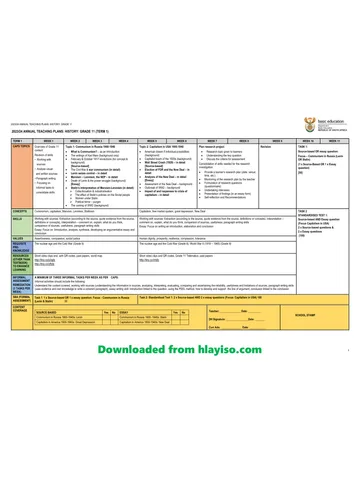
History Grade 11 P2 Eastern Cape November 2019 Memo (Eng)
Grade 11 History Paper 2 memorandum from the Eastern Cape November 2019 (English), 19 pages. Read online or download the free PDF.
History · Grade 11 · Eastern Cape November · 2019 · English. Memorandum, 19 pages. Read online or download the PDF.
- Subject
- History
- Grade
- Grade 11
- Language
- English
- Document type
- Memorandum
- Year
- 2019
- Exam period
- Eastern Cape November
- Paper
- 2
- Curriculum
- CAPS
- Pages
- 19
- File size
- 900.7 KB
Free to read online, no sign-up needed
Loading document…
Loading document…
1 of 19
This exam
Questions in this paper
Document textSearch extracted text and jump to a page.
Downloaded from hlayiso.com
2 HISTORY P2 (EC/NOVEMBER 2019)
1. SOURCE-BASED QUESTIONS
1.1 The following cognitive levels were used to develop source-based
questions:
COGNITIVE WEIGHTING OF
HISTORICAL SKILLS
LEVELS QUESTIONS
Extract evidence from sources
Selection and organisation of relevant 30%
LEVEL 1
information from sources (15)
Define historical concepts/terms
Interpretation of evidence from sources
Explain information gathered from the 50%
LEVEL 2
sources (25)
Analyse evidence from sources
Interpret and evaluate evidence from
sources
Engage with sources to determine its
20%
LEVEL 3 usefulness, reliability, bias and limitations
(10)
Compare and contrast interpretations and
perspectives presented in sources and
draw independent conclusions
1.2 The information below indicates how source-based questions are
assessed:
In the marking of source-based questions credit needs to be given to
any other valid and relevant viewpoints, arguments, evidence or
examples.
In the allocation of marks, emphasis should be placed on how the
requirements of the question have been addressed.
In the marking guideline the requirements of the question (skills that
need to be addressed) as well as the level of the question are indicated
in italics.
When assessing open-ended source-based questions, learners should
be credited for any other relevant answers.
Learners are expected to take a stance when answering ‘to what extent’
questions in order for any marks to be awarded.
1.3 Assessment procedures for source-based questions.
Use a tick () for each correct answer
Pay attention to the mark scheme e.g. (2 × 2) which translates to two
reasons and is given two marks each (); (1 × 2) which translates
to one reason and is given two marks ()
If a question carries 4 marks then indicate by placing 4 ticks ()
Copyright reserved Please turn over
Downloaded from hlayiso.com
(EC/NOVEMBER 2019) HISTORY P2 3
Paragraph question
Paragraphs are to be assessed globally (holistically). Both the content and
structure of the paragraph must be taken into account when awarding a
mark. The following steps must be used when assessing a response to a
paragraph question:
Read the paragraph and place a bullet ( . ) at each point within the text
where the candidate has used relevant evidence to address the
question.
Re-read the paragraph to evaluate the extent to which the candidate has
been able to use relevant evidence to write a paragraph.
At the end of the paragraph indicate the ticks (√) that the candidate has
been awarded for the paragraph; as well as the level (1, 2 or 3) as
indicated in the holistic rubric and a brief comment e.g.
___________ ˖ __________________________ ˖ _________________
_________________ ˖ __________________________ ˖ ___________
√√√√
Level 2
Used mostly relevant evidence to write a basic paragraph
Count all the ticks for the source-based question and then write the mark
on the right-hand bottom margin e.g. 32
50
Ensure that the total mark is transferred accurately to the front/back
cover of the answer script.
2. ESSAY QUESTIONS
2.1 The essay questions require candidates to:
Be able to structure their argument in a logical and coherent manner.
They need to select, organise and connect the relevant information so
that they are able to present a reasonable sequence of facts or an
effective argument to answer the question posed. It is essential that an
essay has an introduction, a coherent and balanced body of evidence
and a conclusion.
2.2 Marking of essay questions
Markers must be aware that the content of the answer will be guided by
the textbooks in use at the particular centre.
Candidates may have any other relevant introduction and/or conclusion
than those included in a specific essay marking guideline for a specific
essay.
When assessing open-ended source-based questions, learners should
be credited for any other relevant answers.
Copyright reserved Please turn over
Downloaded from hlayiso.com
4 HISTORY P2 (EC/NOVEMBER 2019)
2.3 Global assessment of the essay
The essay will be assessed holistically (globally). This approach requires the
teacher to score the overall product as a whole, without scoring the component
parts separately. This approach encourages the learner to offer an individual
opinion by using selected factual evidence to support an argument. The learner
will not be required to simply regurgitate ‘facts’ in order to achieve a high mark.
This approach discourages learners from preparing ‘model’ answers and
reproducing them without taking into account the specific requirements of the
question. Holistic marking of the essay credits learners’ opinions supported by
evidence. Holistic assessment, unlike content-based marking, does not
penalise language inadequacies as the emphasis is on the following:
The learner’s interpretation of the question
The appropriate selection of factual evidence (relevant content selection)
The construction of argument (planned, structured and has independent line
of argument)
2.4 Assessment procedures of the essay
2.4.1 Keep the synopsis in mind when assessing the essay.
2.4.2 During the reading of the essay ticks need to be awarded for a relevant
introduction (indicated by a bullet in the marking guideline), each of the
main points/aspects that is properly contextualised (also indicated by
bullets in the marking guideline) and a relevant conclusion (indicated by
a bullet in the marking guideline) e.g. in an answer where there are 5
main points there will be 7 ticks.
2.4.3 Keep the PEEL structure in mind when assessing an essay.
P Point: The candidate introduces the essay by taking a line of
argument/making a major point.
Each paragraph should include a point that sustains the major
point (line of argument) that was made in the introduction.
E Explanation: The candidate should explain in more detail what
the main point is all about and how it relates to the question
posed (line of argument)
E Example: The candidates should answer the question by
selecting content that is relevant to the line of argument. Relevant
examples should be given to sustain the line of argument.
L Link: Candidates should ensure that the line of argument is
sustained throughout the essay and is written coherently.
Copyright reserved Please turn over
Downloaded from hlayiso.com
(EC/NOVEMBER 2019) HISTORY P2 5
2.4.4 The following additional symbols can also be used:
Introduction, main aspects and conclusion not properly contextualised
Wrong statement ________________
Irrelevant statement
Repetition R
Analysis A√
Interpretation I√
Line of argument LOA
2. The matrix
2.5.1 Use of the matrix in the marking of essays.
In the marking of essays, the criteria as provided in the matrix should be
used. When assessing the essay note both the content and
presentation. At the point of intersection of the content and presentation
based on the seven competency levels, a mark should be awarded.
(a) The first reading of essays will be to determine to what extent the
main aspects have been covered and to allocate the content
level (on the matrix).
C LEVEL 4
(b) The second reading of essays will relate to the level (on the
matrix) of presentation.
C LEVEL 4
P LEVEL 5
(c) Allocate an overall mark with the use of the matrix.
C LEVEL 4
P LEVEL 5 }30 – 33
Copyright reserved Please turn over
Downloaded from hlayiso.com
6 HISTORY P2 (EC/NOVEMBER 2019)
MARKING MATRIX FOR ESSAY ‒ TOTAL: 50
LEVEL 7 LEVEL 6 LEVEL 5 LEVEL 4 LEVEL 3 LEVEL 2 LEVEL 1
Very well Very well Well planned Planned and Shows some Attempts to Little or no
planned and planned and and constructed evidence of structure an attempt to
structured structured structured an argument. a planned answer. structure
essay. Good
essay. essay. Evidence and Largely the essay.
PRESENTATION synthesis of
information. Developed a Attempts to used to constructed descriptive
Developed an relevant line of develop a some extent argument. or some
original, well argument. clear to support Attempts to attempt at
balanced and Evidence argument. the line of sustain a line developing
independent line used to Conclusion argument. of argument. a line of
of argument with defend the drawn from Conclusions Conclusions argument.
CONTENT
the use of
evidence and
argument. the evidence reached not clearly No attempt
sustained and Attempts to to support based on supported by to draw a
defended the draw an the line of evidence. evidence. conclusion.
argument independent argument.
throughout. conclusion
Independent from the
conclusion is evidence to
drawn from
evidence to
support the
support the line line of
of argument. argument.
LEVEL 7
Question has been
fully answered.
Content selection
47–50 43–46
fully relevant to line
of argument.
LEVEL 6
Question has been
answered.
Content selection
43–46 40–42 38–39
relevant to a line of
argument.
LEVEL 5
Question answered
to a great extent.
Content adequately
38–39 36–37 34–35 30–33 28–29
covered and
relevant.
LEVEL 4
Question
recognisable in
answer. 30–33 28–29 26–27
Some
omissions/irrelevant
content selection.
LEVEL 3
Content selection
does not always
relate.
26–27 24–25 20–23
Omissions in
coverage.
LEVEL 2
Sparse content.
Question 20–23 18–19 14–17
inadequately
addressed
LEVEL 1
Question not
answered.
Inadequate content.
14–17 0–13
Significant
irrelevance
*Guidelines for allocating a mark for Level 1:
Question not addressed at all/totally irrelevant content; no attempt to structure the essay = 0
Content selection includes basic and generally irrelevant information; no attempt to structure
the essay = 1–6
Question inadequately addressed and vague; little attempt to structure the essay = 7 – 13
Copyright reserved Please turn over
Downloaded from hlayiso.com
(EC/NOVEMBER 2019) HISTORY P2 7
SECTION A: SOURCE-BASED QUESTIONS
QUESTION 1: HOW DID THE DIFFERENT ORGANISATIONS CONTRIBUTE TO
THE DEVELOPMENT OF AFRIKANER NATIONALISM?
1.1 1.1.1 [Definition of historical concepts from Source 1A – L1]
Uniting people of a particular language group
Any other relevant response (1 x 2) (2)
1.1.2 [Extraction of evidence from Source 1A – L1]
Nation pride (1 x 1) (1)
1.1.3 [Interpretation of evidence from Source 1A – L2]
It promoted the interest of whites only
It was a policy of racial segregation that protected the interest of
whites only
It united the Afrikaners
Its policies advantaged the Afrikaner politically, economically and
socially
Any other relevant response (Any 2 x 2) (4)
1.1.4 [Extraction of evidence from Source 1A – L1]
Afrikaner-Broederbond (Band of Brotherhood)
FAK
National Press
Die Voortrekkers
National Studentbond (Any 2 x 1) (2)
1.1.5 [Interpretation of evidence from Source 1A – L2]
They were also unskilled workers as the black workers
Had to compete with blacks for work on the labour market
Farmers had little knowledge of the work market in the urban
areas
They were ‘poor whites’ that were forced to move to towns in
search of better living conditions
Any other relevant response (Any 2 x 2) (4)
1.2 1.2.1 [Extraction of evidence from Source 1B – L1]
Ossewabrandwag
Economic People’s Congress
Sanlam
Reddingsdaadbond
Afrikaans Trade Institute (Any 2 x 1) (2)
Copyright reserved Please turn over
Downloaded from hlayiso.com
8 HISTORY P2 (EC/NOVEMBER 2019)
1.2.2 [Extraction of evidence from Source 1B – L1]
Churches
Schools
Universities
Business world
Culture
Politics
Media (Any 2 x 1) (2)
1.2.3 [Interpretation of evidence Source 1B – L2]
The Afrikaner nation
The Afrikaans speaking white population
The Volk
Any other relevant response (Any 2 x 2) (4)
1.2.4 [Interpretation of evidence Source 1B – L2]
No other racial groups who were Afrikaans speaking could
become members of the organisation
It was an exclusive organisation for Afrikaans speaking whites
Had be an active member of one of the Afrikaans churches
Had to be male and have the potential to become influential
Any other relevant response (Any 2 x 2) (4)
1.2.5 [Extraction of evidence from Source 1B – L1]
“Nobody was sure who the members of this organisation were”
“One could not apply anywhere to become a member of the
Afrikaner Broederbond” (2 x 1) (2)
1.2.6 [Evaluate the usefulness of the evidence from Source 1C – L3]
This source is useful because:
It was a secret organisation that promoted Afrikaner Nationalism
It was an exclusive organisation that promoted the interests of
Afrikaners only
Its members were influential members of the society
It formed different organisations that would only promote and
protect the interest of the Afrikaner
It abandoned its original principle of being anti-political and
eventually controlled the South African government
Any other relevant response (Any 2 x 2) (4)
1.3.1 [Extraction of evidence from Source 1C – L1]
A semi-military organisation (1 x 1) (1)
Copyright reserved Please turn over
Downloaded from hlayiso.com
(EC/NOVEMBER 2019) HISTORY P2 9
1.3.2 [Extraction of evidence from Source 1C – L1]
To bring total chaos in the country
To eliminate Genl. Smuts and to kidnap his wife
To eliminate Sir Ernest Oppenheimer and all the Jews
To remove all mine and commercial interest out of the hands of the
Jews
To kill the Prime Minister, to arrest all cabinet ministers and to
remove them from their posts and to break the power of the
British Empire in South Africa (Any 1 x 2) (2)
1.3.3 [Interpretation of evidence Source 1C – L2]
Britain controlled South Africa
They hated Britain for the suffering they endured during the South
African War
They did not see Germany as an enemy
They wanted South Africa to become independent
Any other relevant response (Any 2 x 2) (4)
1.4 1.4.1 [Interpretation of evidence from the Source 1D – L2]
To retrace the steps of their forefathers
To remind Afrikaners about their history
To promote Afrikaner solidarity and patriotism
Any other relevant response (Any 2 x 2) (4)
1.4.2 [Interpretation of evidence from the Source 1D – L2]
Afrikaner-Broederbond
Henning Klopper (Any 1 x 2) (2)
1.5 [Interpretation, comprehension and synthesis of evidence from relevant
sources – L3]
Candidates could include the following aspects in their response:
Purified NP laid the foundation for Afrikaner Nationalism (own knowledge)
NP promoted the interests of the Afrikaner (Source 1A)
NP united the Afrikaner (Source 1A)
NP served the social, economic and political interests of the Afrikaner
(Source 1A)
Afrikaner Broederbond wanted to ensure that the Afrikaner get its rightful
place in South Africa (Source 1B)
Afrikaner Broederbond intended to awake a national self-consciousness
amongst Afrikaners (Source 1B)
Formed different organisations to promote Afrikaner Nationalism
(Source 1B)
Ossewabrandwag formed to fight for rights of Afrikaners (Source 1C)
Afrikaner Nationalism revived with centenary celebrations (Source 1D)
Any other relevant response
Copyright reserved Please turn over
Downloaded from hlayiso.com
10 HISTORY P2 (EC/NOVEMBER 2019)
Use the following rubric to allocate marks:
LEVEL CRITERIA MARKS
Uses evidence in an elementary
manner, e.g. show no or little
understanding of how the different
organisations contributed to the MARKS
LEVEL 1
development of Afrikaner 0–2
Nationalism.
Uses evidence partially to report on
topic or cannot write a paragraph.
Evidence is mostly relevant and
relates to a great extent to the topic,
e.g. shows some understanding of
how the different organisations MARKS
LEVEL 2
contributed to the development of 3–4
Afrikaner Nationalism.
Uses evidence in a very basic
manner to write a paragraph.
Uses relevant evidence, e.g.
demonstrates a thorough
understanding of how different
organisations contributed to the
MARKS
LEVEL 3 development of Afrikaner
5–6
Nationalism.
Uses evidence very effectively in an
organised paragraph that shows an
understanding of the topic. (6)
[50]
Copyright reserved Please turn over
Downloaded from hlayiso.com
(EC/NOVEMBER 2019) HISTORY P2 11
QUESTION 2: HOW DID JEWISH NATIONALISM LEAD TO CONFLICT AND
SUFFERING AMONGST THE PEOPLE OF PALESTINE?
2.1 2.1.1 [Definition of historical concepts from Source 2A – L1]
(a) To unite people with the same culture, language, religion
in one country
Any other relevant response (1 x 2) (2)
(b) Belonging to a Jewish nationalist and political movement
Any other relevant response (1 x 2) (2)
2.1.2 [Extraction of evidence from Source 2A – L1]
Theodore Herzl (1 x 1) (1)
2.1.3 [Interpretation of evidence from Source 2A – L2]
To establish Palestine as their homeland
To promote Jewish nationalism
To create a Jewish homeland where all Jews were welcome
Any other relevant response (Any 2 x 2) (4)
2.1.4 [Interpretation of evidence from Source 2A – L2]
The Jews were a nation
Jews were scattered across the world
Jews were persecuted on some parts of Europe
Jews lived in ghettos
Jews should rule themselves
Any other relevant response (Any 2 x 2) (4)
2.2 2.2.1 [Extraction of evidence from Source 2B – L1]
Palestine was divided into a Jewish and Arab state (1 x 2) (2)
2.2.2. [Extraction of evidence from Source 2B – L1]
Britain (1 x 2) (2)
2.2.3 [Interpretation of evidence from Source 2B – L2]
They saw Palestine as an integral part of the Arab world
Jerusalem was of great religious importance to the Muslims
Palestine was promised to them by Britain
The Arab population would remain in Jewish territory under
the partition
Any other relevant response (Any 2 x 2) (4)
2.2.4 [Interpretation of evidence from Source 2B – L2]
The Jews were willing to fight to protect their independence
They were willing to fight for their new-found state, Israel
Any other relevant response (2 x 2) (4)
Copyright reserved Please turn over
Downloaded from hlayiso.com
12 HISTORY P2 (EC/NOVEMBER 2019)
2.2.5 [Interpretation of evidence from Source 2B – L2]
They lost their land to the Israelis
They lost their homes and income
They lost any independence they had hoped for
Any other relevant response (Any 2 x 2) (4)
2.2.6 [Extraction of evidence from Source 2B – L1]
Lebanon
Syria
Iraq
Egypt (Any 3 x 1) (3)
2.3 2.3.1 [Extraction of evidence from Source 2C – L1]
West Bank
Gaza Strip (2 x 1) (2)
2.3.2 [Interpretation of evidence from Source 2C – L2]
She always saw the house as her possession
She hoped to return to it one day
Any other relevant response (Any 1 x 2) (2)
2.3.3 [Evaluate the usefulness of the evidence from Source 2C – L3]
This source is useful because:
It shows the human side of the Palestinian tragedy
It shows that the Arab Palestinians had to flee from their
homes
Have lost their property and only had a skeleton key to show
for it
It gives insight on how Palestinians felt on losing their homes
and is one of the reasons why the conflict will continue
Any other relevant response (Any 2 x 2) (4)
2.4 2.4.1 [Interpretation of evidence from Source 2D – L2]
Arab Palestinians lost everything
They lived in poverty
Arab Palestinians were homeless
Any other relevant response (Any 1 x 2) (2)
2.4.2 [Interpretation of evidence from Source 2D – L2]
No proper homes
Women and children deprived from basic necessities
Any other relevant response (2 x 1) (2)
Copyright reserved Please turn over
Downloaded from hlayiso.com
(EC/NOVEMBER 2019) HISTORY P2 13
2.5 [Interpretation, comprehension and synthesis of evidence from sources –
L3]
Candidates could include some of the following in their response:
The Zionist movement was formed by Theodore Herzl to find a home
for the Jews (Source 2A)
For Biblical reasons they chose Palestine (own knowledge)
Immigration of Jews to Palestine was encouraged (own knowledge)
United Nation divided Palestine (Source 2B)
The Jews established the state of Israel (Source 2B)
Led to the First Israeli War (Source 2B)
Jews prepared to fight for their independence (Source 2B)
Led to conflict in the Middle East (own knowledge)
Led to Arab Palestinians becoming refugees (Source 2C)
People lost their homes (Source 2C)
People hoped conflict would end and return to their homes (own
knowledge)
Arab Palestinians lived in poverty caused by the conflict (Source 2D)
Any other relevant response
Use the following rubric to allocate marks:
LEVEL CRITERIA MARKS
Uses evidence in an elementary
manner, e.g. shows no or little
understanding on how Jewish
Nationalism led to conflict and MARKS
LEVEL 1
suffering for the people of 0–2
Palestine.
Uses evidence partially to report on
topic or cannot write a paragraph.
Evidence is mostly relevant and
relates to a great extent to the topic,
e.g. shows an understanding on
how Jewish Nationalism led to MARKS
LEVEL 2
conflict and suffering for the 3–4
people of Palestine.
Uses evidence in a very basic
manner to write a paragraph.
Uses relevant evidence, e.g.
demonstrates a thorough
understanding on how Jewish
Nationalism led to conflict and
MARKS
LEVEL 3 suffering for the people of
5–6
Palestine.
Uses evidence very effectively in an
organised paragraph that shows an
understanding of the topic. (6)
[50]
Copyright reserved Please turn over
Downloaded from hlayiso.com
14 HISTORY P2 (EC/NOVEMBER 2019)
QUESTION 3: HOW DID THE PASS LAWS AFFECT THE LIVES OF BLACK
SOUTH AFRICANS IN THE 1950s?
3.1 3.1.1 [Definition of historical concepts from Source 3A – L1]
The political, economic and social segregation of races based on
their skin colour
Any other relevant response (1 x 2) (2)
3.1.2 [Extraction of evidence from Source 3A – L1]
Abolition of Passes and Consolidation of Documents Act (1 x 1) (1)
3.1.3 [Extraction of evidence from Source 3A – L1]
Unemployed for long periods
Judged redundant to the needs of the white population
Ill-health
Old age (Any 2 x 1) (2)
3.1.4 [Interpretation of evidence from Source 3A – L2]
They could not become permanent residents in the urban areas
After their contracts expired, they had to return to the homeland
No African could leave the rural areas without a permit from the
local authorities
Had to find work within seventy-two hours in the urban area
Any other relevant response (Any 2 x 2) (4)
3.2 3.2.1 [Extraction of evidence from Source 3B – L1]
Pass
Tax receipt (2 x 1) (2)
3.2.2 [Interpretation of evidence from Source 3B – L2]
Rude
In control
Harsh
Superior
Any other relevant response (Any 2 x 2) (4)
3.2.3 [Interpretation of evidence from Source 3B – L2]
Did not see his father as a hero anymore
Shameful toward his father
Resentment towards his father for allowing the younger
policeman to address him impolitely
Any other relevant response (Any 2 x 2) (4)
3.2.4 [Extraction of evidence from Source 3B – L1]
Calm
Gentleness
Hardness (Any 2 x 1) (2)
Copyright reserved Please turn over
Downloaded from hlayiso.com
(EC/NOVEMBER 2019) HISTORY P2 15
3.2.5 [Evaluate the usefulness of the evidence from Source 3B – L3]
This source is useful because:
Eyewitness account on how the pass laws were implemented
It reveals how black people were degraded in front of their
children
The source reveals the superiority of the policeman and
demanded passes
Houses of black people could be raided at any time of day or
night
Black South Africans had no say on the intrusion of their privacy
Any other relevant response (Any 2 x 2) (4)
3.3. 3.3.1 [Interpretation of evidence from Source 3C – L2]
It reveals the pass laws being implemented
Black South Africans could be stopped anywhere to produce
their passes to the police
Any other relevant response (Any 1 x 2) (2)
3.3.2 [Interpretation of evidence from Source 3C – L2]
To see if he /she was legally in South Africa
To established where they stayed and worked
Any other relevant response (2 x 2) (4)
3.3.3 [Interpretation of evidence from Source 3C – L2]
Imprisoned
Fined
Send to work on farms for free
Any other relevant response (Any 2 x 2) (4)
3.4 3.4.1 [Extraction of evidence from Source 3D – L1]
It was a deliberate instrument of humiliation for the black people
A hallmark for slavery
A weapon used by the authority to keep blacks in an inferior
position (3 x 1) (3)
3.4.2 [Extraction of evidence from Source 3D – L1]
“how deep rooted the repulsion for the pass system among
blacks is” (1 x 2) (2)
3.4.3 [Interpretation of evidence from Source 3C – L2]
The pass system immediately be abolished
All discriminating laws be abolished
Black South Africans get political rights
All people of South Africa be treated as equal
Any other relevant response (Any 2 x 2) (4)
Copyright reserved Please turn over
Downloaded from hlayiso.com
16 HISTORY P2 (EC/NOVEMBER 2019)
3.5 [Interpretation, comprehension and synthesis of evidence from sources – L3]
Candidates could include some of the following in their response:
Not all black South African had the right to become permanent residence
of South Africa (Source 3A)
Restricted blacks right to move to another town (Source 3A)
Right to stay in a particular town could be revoked (Source 3A)
Pass raids were held anytime (Source 3B)
The pass raid diminished Modisane’s image of his father (Source 3B)
Hero image of his father crumbled by the raid (Source 3B)
Pass raid destroyed his father (Source 3B)
Black South Africans could be stopped anywhere, anytime by
police officers to produce their passes (Source 3C)
Black South Africans could be jailed, fined or send to work for free on
farms failing to produce their passes (own knowledge)
It caused pain and suffering for Black South Africans (Source 3D)
Pass Laws humiliated black South Africans (Source 3D)
Kept blacks in an inferior position (Source 3D)
It prevented husbands and wives to live together and separated children
from their parents (Source 3D)
Any other relevant response
Use the following rubric to assess this paragraph.
LEVEL CRITERIA MARKS
Uses evidence in an elementary manner, e.g.
shows no or little understanding of how
the Pass Laws affected the lives of black MARKS
LEVEL 1
South Africans in the 1950’s. 0–2
Uses evidence partially to report on the topic
or cannot write a paragraph.
Evidence is mostly relevant and relates to a
great extent to the topic, e.g. shows some
understanding of how the Pass Laws
MARKS
LEVEL 2 affected the lives of black South Africans
3–4
in the 1950’s.
Uses evidence in a very basic manner to
write a paragraph.
Uses relevant evidence, e. g. demonstrates
a thorough understanding of how the Pass
Laws affected the lives of black South
MARKS
LEVEL 3 Africans in the 1950’s.
5–6
Uses evidence very effectively in an
organised paragraph that shows an
understanding of the topic. (6)
[50]
Copyright reserved Please turn over
Downloaded from hlayiso.com
(EC/NOVEMBER 2019) HISTORY P2 17
SECTION B: ESSAY QUESTIONS
QUESTION 4: NATIONALISM IN SOUTH AFRICA: AFRICAN NATIONALISM
[Plan and construct an original argument based on relevant evidence using analytical
and interpretative skills.]
SYNOPSIS
Candidates should take a stance on whether black South Africans were deprived of
their political, economic and social rights that paved the way for the rise of African
Nationalism.
MAIN ASPECTS
Candidates should include the following aspects in their response:
Introduction: Candidates need to take a stance and demonstrate if they agree or
disagree with the statement.
ELABORATION
Started as a form of resistance to colonialism/segregation
Formation of the APO in 1902 by Dr Abdurahman
Protested against the exclusion of blacks from the right to vote
Delegation to London in 1905 to achieve non-racial franchise, end discrimination
and the right to vote to blacks. Britain ignored the request
Formation of the SANNC in 1912 to oppose discrimination and to win political
rights
SANNC wanted to unite everyone who was oppressed by whites
SANNC sent a delegation to London in 1914 to appeal against the Native Land
Act but they were not successful
In 1923 the SANNC changed its name to the ANC
Formation of ICU in 1919 addressing the grievances of the black dock workers –
fought against government policies
ICU had mass support – ANC had the support of the elite
Formation of the SACP addressing black workers’ grievances
Spread of education led to growing awareness of the ideas of freedom and
democracy
The influence of World War Two – many blacks involved fought for freedom and
democracy
Young members of the ANC became more militant and formed the ANC Youth
League
Youth League accused the ANC of representing the elite and not the masses
1953 saw the ANC Freedom Charter call for a democratic South Africa regardless
of race
Pan Africanism aimed to free black people all over the world
Any other relevant response
Conclusion: Candidates should tie up their argument with a relevant conclusion. [50]
Copyright reserved Please turn over
Downloaded from hlayiso.com
18 HISTORY P2 (EC/NOVEMBER 2019)
QUESTION 5: NATIONALISM IN AFRICA: GHANA
[Plan and construct an original argument based on relevant evidence using analytical
and interpretative skills]
SYNOPSIS
Candidates should explain to what extent Kwama Nkrumah was influenced by Pan-
Africanism and led Ghana to independence.
MAIN ASPECTS
Introduction: Learners should indicate to what extent they agree with the statement
and support their argument with relevant historical evidence.
ELABORATION
Background – role played by WEB Du Bois, Marcus Garvey and George Padmore
in spreading Pan Africanism
Early nationalism among the educated elite who knew concepts like democracy and
nationalism
Educated elite became critical of colonial rule
British companies exploited Ghana cocoa farmers
Resistance tactics: 1937 nationwide strike of cocoa farmers
Farmers were supported by dock and transport workers – strike became a
nationalist movement against British political control
Strike was a success and encouraged further nationalist support
Many blacks fought in World War Two for democracy and freedom
Nkrumah attended the Pan Africanist conference
After the conference the nationalist ideas became more militant to liberate Ghana
Nkrumah asked to become the secretary of the UGCC
The UGCC became a dynamic political movement
1948 – boycotts and uprisings organised against British goods and control
Nkrumah left the UGCC and formed a more radical nationalist party, the Convention
People’s Party (CPP), which demanded self-government right away
The CPP had mass support and adopted a policy of African socialism
Britain gave limited power of self-rule to Ghana
Nkrumah was arrested
CPP continued their struggle and won the 1957 elections
Nkrumah became the first president of the Gold Coast and renamed it Ghana
Any other relevant response
Conclusion: Candidates should tie up their argument with a relevant conclusion. [50]
Copyright reserved Please turn over
Downloaded from hlayiso.com
(EC/NOVEMBER 2019) HISTORY P2 19
QUESTION 6: APARTHEID SOUTH AFRICA: 1940s to 1960s
[Plan and construct an original argument based on relevant evidence using
analytical and interpretative skills]
SYNOPSIS
Candidates should take a stance on whether the National Party government
enforced its apartheid policy so effectively in the1950s that there was no resistance.
MAIN ASPECTS
Introduction: Candidates must indicate whether the statement is accurate or not.
ELABORATION
ANC’s Program of Action
ANC became more militant
Used boycotts, civil disobedience and uprisings as means of resistance
May day stay-away
Defiance Campaign
1952 – break laws on purpose – enter whites-only facilities
Burn passes in public
Refused to pay fines and wanted jails to become overfull
Hoped that the apartheid system would crumble
Some killed and arrested
Congress Alliance
Conference held of all racial groups to draw up a constitution
Freedom Charter
Met at Kliptown on 25 and 26 of June 1955
Set a document that represented the aspirations of all South Africans
Became the blue print for the new constitution of South Africans
Women’s march to Pretoria (9 August 1956)
Women forced to carry passes
20 000 women of all races marched to the Union Building
Leaders of the march – Lilian Ngoyi, Rahima Moosa, Sophie Williams and Helen
Joseph
Prime Minister, J.G. Strijdom, refused to see the women
When they left, sang ‘Nkosi Sikeleli Africa’
High treason
Defiance against apartheid led to the arrest of members of the Congress Alliance
Arrested for attempt to overthrow the government
In 1956 the state arrested 156 activists
Hearing took place at “Drill Hall” for two years
Aim of government was to intimidate people and lead to weakening of resistance
By 1961 all accused were set free
Any other relevant response
Conclusion: Candidates should tie up their argument with a relevant conclusion. [50]
TOTAL: 150
Copyright reserved Please turn over
Study this subject
Recommended for this subject
Memorandum
History Grade 11 P1 Eastern Cape November 2019 Memo (Eng)
Memorandum
History Grade 11 P2 Eastern Cape November 2020 Memo (Eng)
Memorandum
History Grade 11 P2 Eastern Cape November 2016 Memo (Eng)
Addendum
History Grade 11 P2 Eastern Cape November 2022 Addendum
Question paper
History Grade 11 P2 Eastern Cape November 2022 QP (Eng)
Addendum
History Grade 11 P2 Eastern Cape November 2020 Addendum
More from Grade 11 History
Annual teaching plan
Gr 11 His ATP 2023 24
Question paper
History Grade 11 P1 Eastern Cape June 2025 Question Paper
Question paper and memo
History Grade 11 Paper 2 Eastern Cape June 2025 Paper & Memo
Question paper
History Grade 11 P1 Eastern Cape November 2025 QP (Eng)
Question paper
History Grade 11 P2 Eastern Cape November 2025 QP (Afr)
Question paper